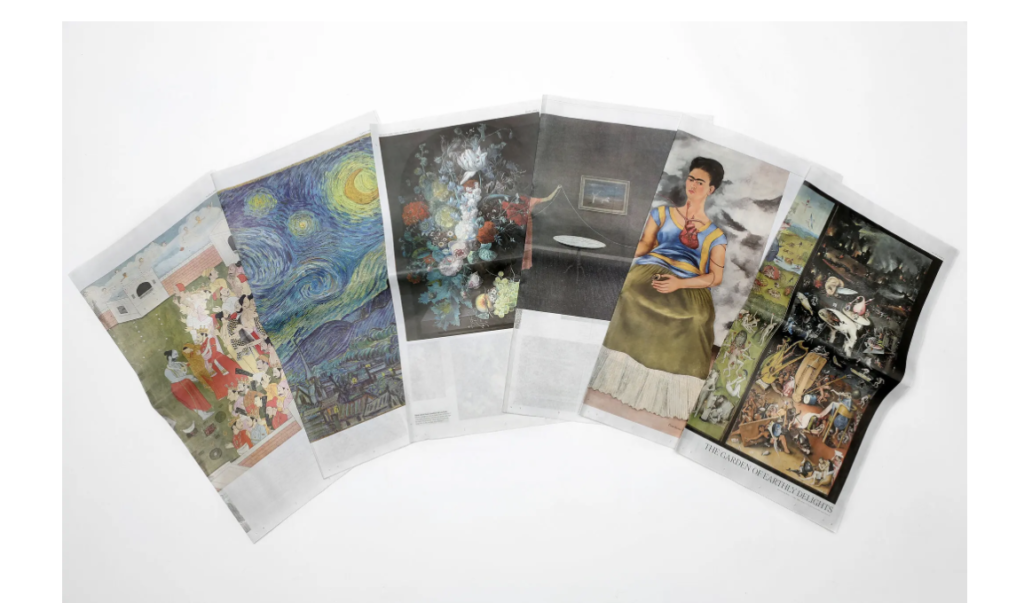
Image courtesy of The New York Times
As readers of this blog know, I am not one for poetic reminiscing about the glory days of printed newspapers — the smell of ink on paper, the romantic nostalgia for a platform that is no longer in its prime. However, like the aging star Norma Desmond in the iconic film Sunset Boulevard, print still surprises from time to time, especially when it gets ready for its close-up, as it did with this visually powerful special section.
Let’s lean back with the Times
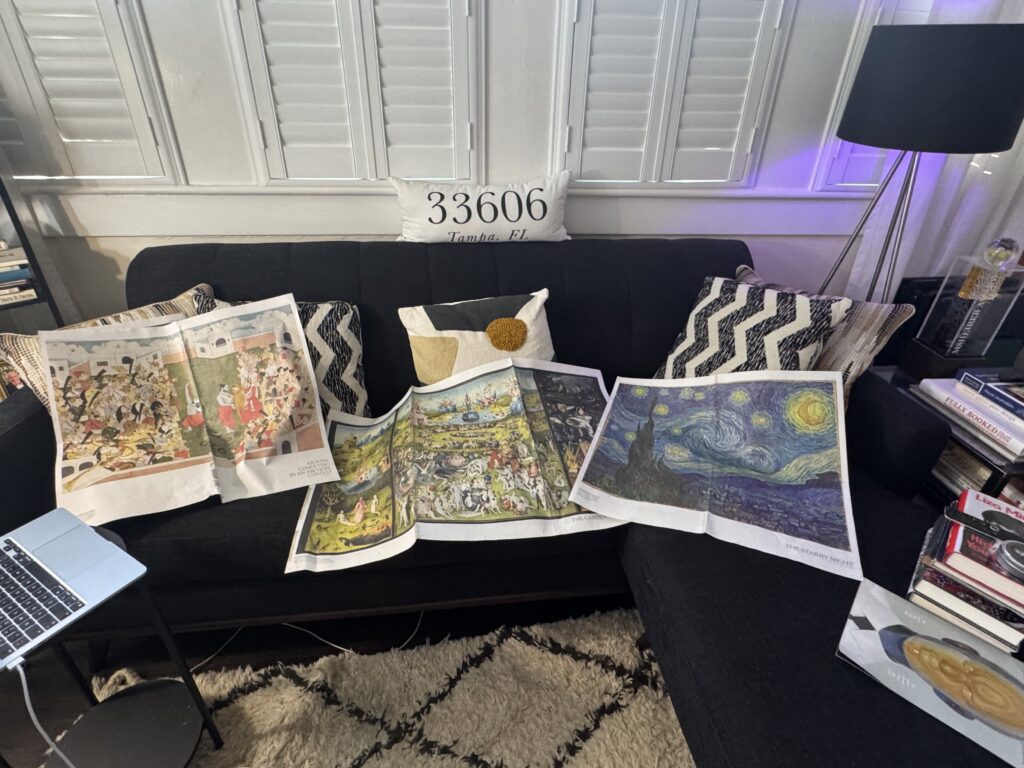
Color my couch happy as I spread out these double and triple pages to admire the art pieces.
I have said repeatedly that in the digital age of mobile storytelling — with large percentages of readers consuming news via their phones — print has become a lean-back platform. The phone allows for the journalism of interruptions: we read on trains, planes, buses, at the gym, even in church. Print invites the opposite. Those who read books and newspapers in printed form go for the “let me take off my shoes, lie on the couch, and turn the phone off” mode.
This special section understands that completely. Past the front page, the next headline — centered in a sea of white space — reads: Welcome. Settle In. We want you to spend some uninterrupted time looking at these six artworks. Take 10 minutes. Or an hour. Or 100 hours.
When was the last time anyone suggested you take 100 hours reading on your iPhone?
The first line of the section’s text asks: “Could we design an article that truly gets people to slow down?” It’s a tough challenge in an era when, as the editors acknowledge, our ability to focus has been eroded by a modern media that constantly nibbles at our attention. The Times team drew inspiration from Oliver Burkeman’s book Four Thousand Weeks— about the absurdly brief time we have on this earth — and from an assignment Harvard history professor Jennifer Roberts gives her students: go to a museum, pick one work of art, and look at it for three hours.
The section is so committed to the lean-back experience that it carries no page numbers, as if inviting the reader to move gingerly through its beautiful images in a meditative mode — something we rarely associate with consuming content on a mobile device.
The second great strength on display here is one I remind editors of in every newsroom workshop I conduct: nobody does large photography like a broadsheet newspaper or magazine. Our phones are the smallest possible canvas on which to read text and view images. We can incorporate audio and video in mobile storytelling, but we can never stop a reader cold with a single large image the way a broadsheet page can.
The Case for Large


The Times’s designers made special use of double and sometimes triple-page spreads to display the art as large as possible. What a visual treat.
The Times team knows this well. As they note about the section: “One of our newspaper’s strengths is its size. A phone is just a few inches wide, but at nearly two feet, a broadsheet spread is the size of a poster — larger even than the dimensions of one of our selected artworks.”
They also raised the production standard to match the ambition. The editors chose higher-quality paper — a heavier, bright white newsprint typically reserved for the Sunday Styles section — because if they were asking readers to truly look at art, the reproduction had to be worthy of the ask.
This special section is as if The New York Times added an extra bonbon to its already delicious Sunday box of chocolates. The Sunday print edition is the only print product I consume regularly, alongside some books. I see it at my front door early Sunday morning and work through a dozen sections — sometimes two magazines — coffee in hand, engaged in that old ritualistic, uninterrupted journalism.
The Times editors put it simply and well: “Print quietly offers the most distracted among us a suggestion: With a newspaper, you can disconnect from insistent dings, buzzes and push notifications without turning away from the world.”
Amen
The Power to Disconnect
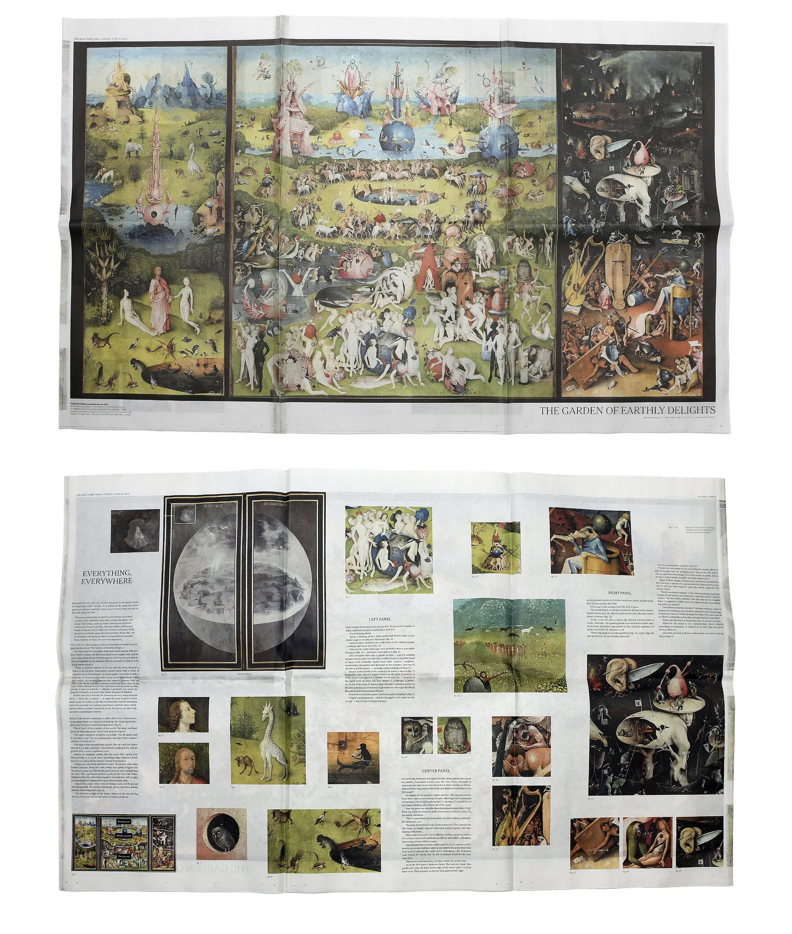
The special section does not include advertisements.
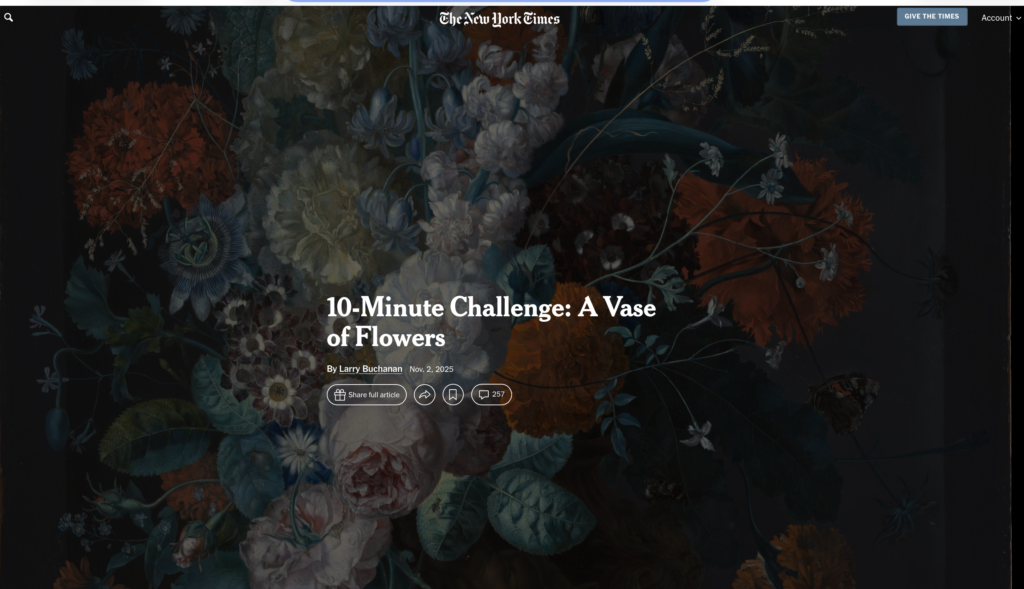
The section grew out of an online series the Times has been publishing since 2024 called the 10-Minute Challenge (screenshot below)— a monthly invitation for readers to look at a work of art for ten minutes, scrolling and zooming around a high-resolution image before learning more about the piece. What the print edition does is take that digital idea and give it the space a phone screen simply cannot provide.
“We wanted to amplify qualities of the internet while celebrating the print reading experience,” the editors write.
That is exactly what they achieved. And on a Sunday morning, shoes off, phone face-down on the table, it is a reminder that some experiences are still best delivered on paper.
Consulting with Heart

Consulting with Heart — my 17th book—is here! Ready to order. Thanks for making it already the #1 Hot New Release for Media & Communications Books at Amazon.com. Also available from Apple, Barnes & Noble, Target, Torchlight.
Written from my more than 200 diaries. Fueled by people I have met along the way in my journey through 122 countries, this book isn’t just about strategy. It is about my five-decade journey, 750+ projects and my role as an interpreter of dreams for my clients.
amazon.com/dp/1966629958; Apple Books – ebook
Workshop deals with the two big revolutions facing editors
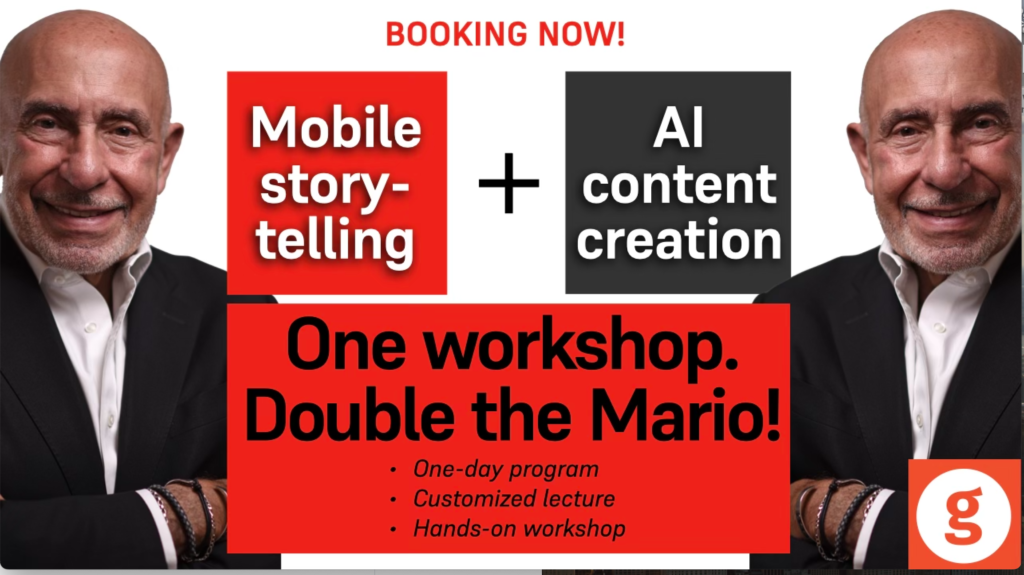
For me, it is imperative that editors approach content creation thinking in terms of mobile first.
Mobile first involves the type of transformation where all content is prepared thinking from small to large platform. Thinking small platform does not mean that the reporter conceptualizing a story for mobile consumption should not think BIG. So, plan from small to large, but think big in terms of the story content and the visual assets that go with it.
While mobile first is still elusive to so many newsrooms around the planet, here we are, in 2024, faced with an even bigger challenge not just knocking at our doors, but already IN: Artificial Intelligence.
Transformation and a change of mentality to face these challenges is the first step. Training and education to tackle them with a sense of focus and direction is essential.
That’s where our Garcia Media workshops come in
Our Garcia Media Mobile Storytelling workshops introduce your editorial team to the way we write, edit and design for mobile platforms. This one-day program includes a presentation and a hands-on workshop. We’ve added a new segment about AI for content creation.
Mobile first involves the type of transformation where all content is prepared thinking from small to large platform. Thinking small platform does not mean that the reporter conceptualizing a story for mobile consumption should not think BIG. So, plan from small to large, but think big in terms of the story content and the visual assets that go with it.
While mobile first is still elusive to so many newsrooms around the planet, here we are, in 2024, faced with an even bigger challenge not just knocking at our doors, but already IN: Artificial Intelligence.
Transformation and a change of mentality to face these challenges is the first step. Training and education to tackle them with a sense of focus and direction is essential.
That’s where our Garcia Media workshops come in!
Our Garcia Media Mobile Storytelling workshops introduce your editorial team to the way we write, edit and design for mobile platforms. This one-day program includes a presentation and a hands-on workshop. We’ve added a new segment about AI for content creation.
Newsrooms around the planet have gone mobile-first after a Garcia Media workshop!
Our Garcia Media Mobile Storytelling workshops are proven to introduce your editorial team to the way we write, edit and design for mobile platforms. It is a one-day program that involves a presentation (where I summarize my Columbia University class content), and follow it with a hands on workshop.
For details, to customize, and to book: mario@garciamedia.com
How we use AI
Honored to be mentioned here:
https://www.newsroomrobots.com/p/how-10-news-industry-leaders-use
Order my AI book here:
https://thaneandprose.com/…/preorder-ai-what-to-expect…
TheMarioBlog post #4023