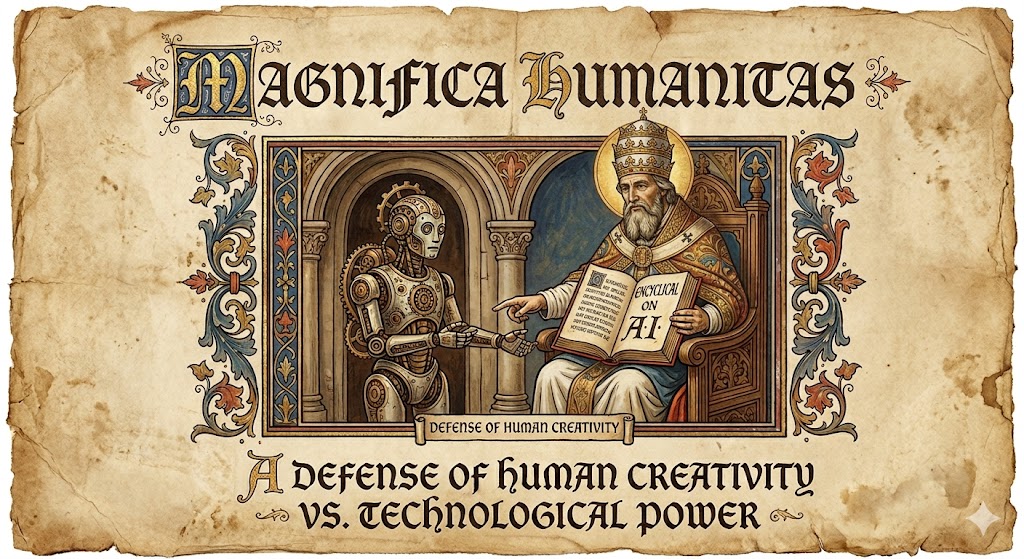
Google.Gemini created image based on Mario Garcia concept.
This comes at a particular moment in my own career. I sit here in Amsterdam, putting the finishing touches on a presentation about AI for a group of journalists and media executives, while also working through the final edits of my new book, The Virtuoso Machine: Finding the Scent of the Human at the Controls of AI. The timing feels almost conspiratorial — in the best sense.
The Pope’s encyclical, titled Magnifica Humanitas — Magnificent Humanity — stands out in a sea of AI-related headlines, most of which are technical, most of which are about speed, scale, and disruption. The Pope and I take a deliberate detour from AI and technology and concentrate, instead, on AI and humans. That detour, I believe, is the road that matters most.
I had been anxiously awaiting this document. Hoping, frankly, that the Holy Father and I would find common ground on the importance of humans in the age of artificial intelligence. I am happy to report: we do. Emphatically.
So today, as a Catholic, I walk with a little papal spring in my step. And as an author and professor, I am deeply gratified by the reaffirmation that my foundational idea — that AI is the machine, but the human is the muse — has now received a Vatican blessing.
Here is where the Pope and The Virtuoso Machine align:
1. AI Is a Tool. You Are the Conductor.
The encyclical’s most fundamental declaration is that artificial intelligence must serve humanity — not replace it, not diminish it, not redefine it. AI is an instrument of human will, not a substitute for human judgment.
This is the very spine of everything I have written and lectured about for the past several years. In The Virtuoso Machine, I describe the human leader as the conductor of the orchestra, and AI as the most magnificent instrument in the pit. Powerful? Absolutely. Indispensable? Increasingly so. But silent without the conductor’s vision.
I have watched organizations fall into the trap of handing the baton to the machine — letting AI set the agenda, determine the tone, and make the calls that only human experience and conscience can make responsibly. Pope Leo sees the same danger. His encyclical is, among other things, a firm reminder that tools do not lead. People do.
2. The Scent of the Human Cannot Be Synthesized
Pope Leo insists that the irreplaceable qualities of human creativity — empathy, moral judgment, spiritual depth, the ability to feel — must be actively protected in the age of AI. He is not being romantic or nostalgic. He is being precise.
I have been writing about this under the phrase The Scent of the Human — that irreducible quality in our communication, our leadership, our storytelling, that no algorithm can replicate because no algorithm has ever loved, lost, feared, or dreamed. AI can process every poem ever written. It cannot write the one that comes from your specific grief or your specific joy.
The encyclical gives this idea theological weight. The human person, in Catholic teaching, is made in the image of God — endowed with a dignity and a creative spark that is not transferable to code. For secular readers, think of it this way: there are things your team can do that the machine simply cannot, because those things require having lived a human life. Protect those things. Develop those things. They are your competitive advantage and your moral responsibility.
3. The Blue Note Is an Act of Dignity
The encyclical contains a striking warning against what happens when AI-generated content floods our cultural and spiritual life — the flattening of creative voice, the homogenization of expression, the disappearance of the unexpected and the genuinely personal. Pope Leo went so far as to caution priests not to let chatbots write their homilies. That line stopped me cold — because it is precisely my argument, delivered from the pulpit. Yet, when I do workshops for priests, I encourage them to use AI as the crane that can do the heavy lifting with data and research.
In The Virtuoso Machine, I describe what I call the Blue Note — that intentionally imperfect, beautifully human choice that makes a piece of music, a piece of writing, a design, a conversation feel alive. Jazz musicians know this instinctively. The note that shouldn’t work, that shouldn’t be there, but is — and suddenly everything clicks into place. That note cannot come from a prompt. It comes from personality, from risk, from the willingness to be yourself in public. Think of Billie Holiday and Ella Fitzgerald, two virtuosos of the Blue Note.
When an organization lets AI write its homilies — whether those are actual homilies, or leadership messages, or editorial voices, or brand communications — it loses its Blue Note. And with it, its soul.
4. Slow Down to Become More Human
This may be the most counter-cultural thing in the encyclical: Pope Leo calls for prudence and a slower pace in AI adoption. Not as a brake on progress, but as what he describes as responsible care for the human family.
We live in an era of AI acceleration that borders on the frantic. Every week brings a new model, a new capability, a new reason to feel behind. The pressure to automate, to scale, to optimize is relentless. The Pope says: stop. Breathe. Ask what you are doing to the people in your care.
I call this the Water Fountain — the unhurried, face-to-face human exchange where real transformation happens, where a young journalist learns not from a textbook but from an editor’s story, where a team finds its coherence not in a dashboard but over coffee. These moments are not inefficiencies. They are the infrastructure of humanity inside an organization. Pope Leo is telling us not to pave over them in the rush to automate everything.
Slow down to become more human. In my workshops, I say this almost every session. It is good to hear it echoed from Rome.
5. The Goal Is the Augmented Humanist
The encyclical closes not with fear but with aspiration. Pope Leo’s vision is not of a Church — or a world — diminished by technology, but elevated by it, provided the human spirit remains sovereign. He believes AI can serve justice, heal the sick, protect the vulnerable, and expand human possibility. But only if the humans steering it are morally awake and spiritually grounded.
The Virtuoso Machine closes with the same vision, expressed for business leaders and communicators: the goal is not to compete with AI, not to fear it, not to surrender to it — but to emerge from the encounter with it more fully yourself. More creative, more humane, more distinctive. I call this the Augmented Humanist: the leader who uses AI as the extraordinary amplifier it is, while never confusing the amplifier for the music.
Pope Leo and I agree: the machine is magnificent. The human is the muse.
I am hoping that organizations all over the globe will continue to see AI as a formidable tool that humans can collaborate with — to develop ideas, to discover new life-saving medicines and treatments, to find new efficiencies in how we serve communities and tell stories, and yes, to find new songs and poetry that we could not have found alone.
The encyclical Magnifica Humanitas arrives at exactly the right moment. When so much of the conversation about AI is dominated by technical benchmarks, market valuations, and existential dread, it is bracing — and, for me, deeply moving — to hear the highest moral authority in the Catholic world say: the magnificent thing here is not the algorithm.
It is the humanity.
Consulting with Heart

Consulting with Heart — my 17th book—is here! Ready to order. Thanks for making it already the #1 Hot New Release for Media & Communications Books at Amazon.com. Also available from Apple, Barnes & Noble, Target, Torchlight.
Written from my more than 200 diaries. Fueled by people I have met along the way in my journey through 122 countries, this book isn’t just about strategy. It is about my five-decade journey, 750+ projects and my role as an interpreter of dreams for my clients.
amazon.com/dp/1966629958; Apple Books – ebook
Workshop deals with the two big revolutions facing editors
For me, it is imperative that editors approach content creation thinking in terms of mobile first.
Mobile first involves the type of transformation where all content is prepared thinking from small to large platform. Thinking small platform does not mean that the reporter conceptualizing a story for mobile consumption should not think BIG. So, plan from small to large, but think big in terms of the story content and the visual assets that go with it.
While mobile first is still elusive to so many newsrooms around the planet, here we are, in 2024, faced with an even bigger challenge not just knocking at our doors, but already IN: Artificial Intelligence.
Transformation and a change of mentality to face these challenges is the first step. Training and education to tackle them with a sense of focus and direction is essential.
That’s where our Garcia Media workshops come in
Our Garcia Media Mobile Storytelling workshops introduce your editorial team to the way we write, edit and design for mobile platforms. This one-day program includes a presentation and a hands-on workshop. We’ve added a new segment about AI for content creation.
Newsrooms around the planet have gone mobile-first after a Garcia Media workshop!
Our Garcia Media Mobile Storytelling workshops are proven to introduce your editorial team to the way we write, edit and design for mobile platforms. It is a one-day program that involves a presentation (where I summarize my Columbia University class content), and follow it with a hands on workshop.
For details, to customize, and to book: mario@garciamedia.com
How we use AI
Honored to be mentioned here:
https://www.newsroomrobots.com/p/how-10-news-industry-leaders-use
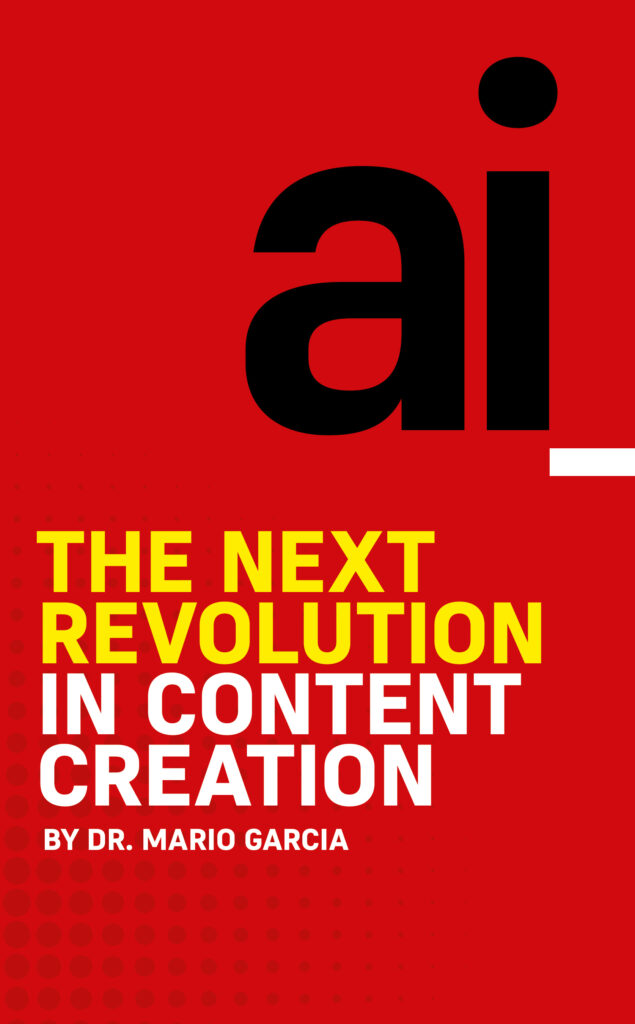
Order my AI book here:
https://thaneandprose.com/…/preorder-ai-what-to-expect…
TheMarioBlog post #4020