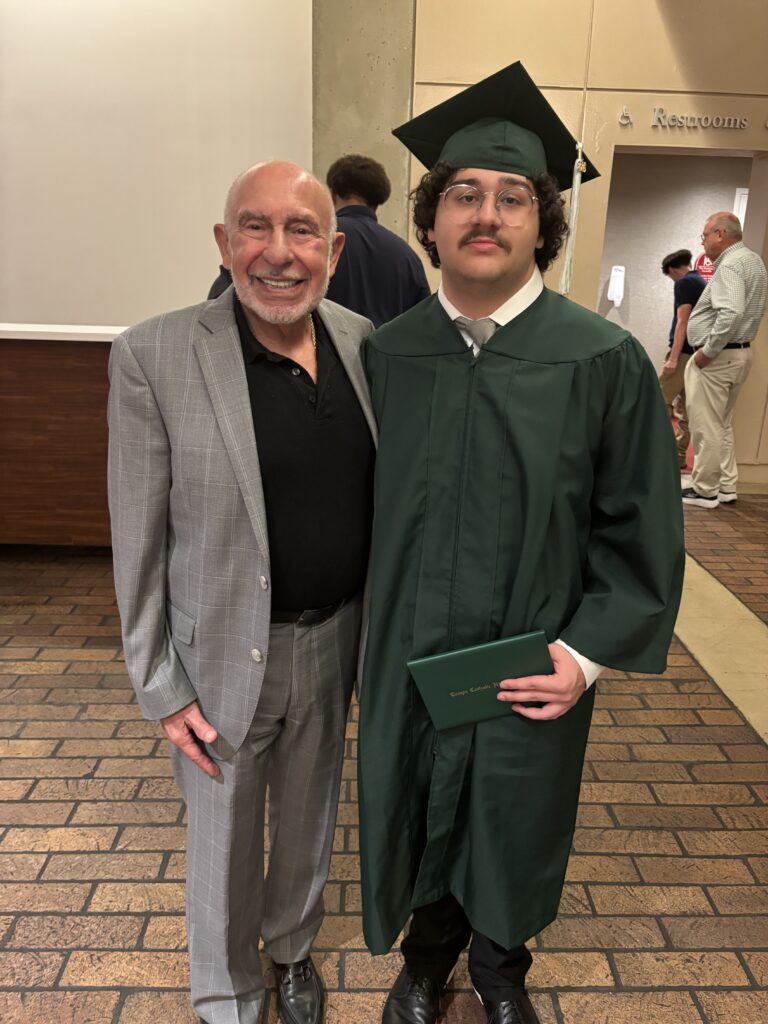
My grandson Frank Joseph Barravecchio, during graduation ceremony at Tampa Catholic High School, May 15, 2026.
It’s graduation season and I am forecasting that the most important diploma being handed out in 2040 will not be printed on parchment. It will be encoded in something far more fragile and far more precious: the irreplaceable, messy, unpredictable scent of the human.
I thought about that future recently as I watched my grandson Frank walk across a stage to collect his high school diploma. Around me, a packed auditorium hummed with pride, cameras raised, families leaning forward. But my mind kept drifting — not backward, to the boy I watched grow up, but forward, to this same auditorium in 2040, filled with graduates who will have spent their entire lives in partnership with an AI bestie. Not as a novelty. Not as a tool. As a companion.
When I was the Bestie
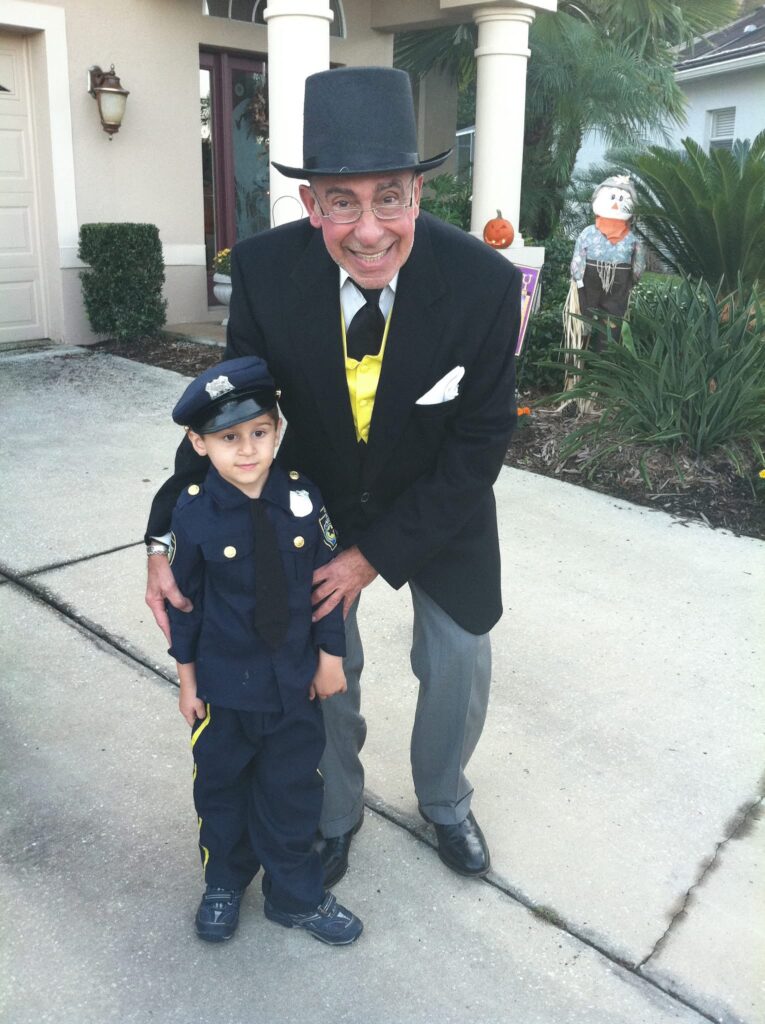
One Halloween Frankie and I went trick-or–treating together. I was Sir Topham Hat.
I know something about being Frank’s companion. Long before any bot had the job, Idid.
Like all boys of his generation, Frankie—as we called him then—had a fascination with all things Thomas the Train. One Halloween I dressed as Sir Topham Hat to go trick-or-treating with him.
We used to play Thomas the Train. The moment I would come into the living room of his house Frank would jump up and say: “Abo, let’s go upstairs to my room so that you can build me a track.”
Thomas the Train follows its characters and situations with the rigid logic of plastic tracks — the story always loops back, the engine always stays on course. From time to time, I would spice things up a bit, as when I would pull two plastic miniature cows out my pocket and yell: “Percy, we have cows on the tracks.” This was so unexpected that Frankie would drop part of the set he was holding, excited by the surprise.
I had played the blue note, taken a detour from the script. While the toy train (the machine) followed the rigid, circular logic of the plastic tracks, I was the one who injected the juice and the surprise of imperfection. I played the Blue Note—an intentional dissonance that machine would avoid as “noise” or “data contamination”. The machine seeks the wall of gray (the predictable path), but the human seeks the surprise. I was the director at the controls of that theater in Frankie’s bedroom, providing the scent of the human—that messy, unpredictable intuition —that transformed a mechanical routine into a lasting memory.
My mind shifts to the graduation ceremony but in 2040, a time when this auditorium will be filled with students who have never known a world without a “Bestie” in their pocket. By then, their relationship with AI will have reached a lifelong companionship status.
.
Two Decades with AI Bestie
Frank’s 2040 counterparts will be celebrating more than just a diploma; they will be marking two decades of a partnership with a non-person co-intelligence. This partner has been their Socratic coach, pushing them through the friction where character lives, rather than a crutch that smoothed their path.
Their bestie bot has helped them with that Hemingway and masculinity theme English paper, or with writing the emails to accompany college applications. Some AI Besties know their human friend so well that they may be writing the personal essay to go with the application, and remembering details that the applicant had forgotten.
What happens when your bestie is a robot with access to the biggest and richest library in the world, but who does not have opinions, soul or taste? The limitations are real, but so is the gift. Your bestie will not call you at 3 in the morning to discuss his breakup. He will not hold a grudge, project his insecurities onto your work, or bring last Tuesday’s argument into today’s conversation. This bestie lives in a world of perfect patterns — every work in his vast library filed after its author committed to a final version. Shakespeare rewrote the ending of King Lear so many times that scholars still debate which version he truly meant — but the bestie holds only the seemingly perfect one. And therein lies the paradox: what makes the bestie so useful is precisely what makes him insufficient. He has never been wrong in the way that teaches you something. He has never failed beautifully Co-Intelligence — a term popularized by Wharton professor Ethan Mollick — is not antitechnical term; it is a relationship: what happens when artificial intelligence and human creativity stop competing and start composing together. Think of it as a jazz duet between a musician who has memorized every song ever written and one who has never played the same phrase twice. The machine brings the archive; you bring the surprise, as I did for Frankie when I pulled the two plastic cows out of my pocket.
Next: Quantum Computing
The members of the class of 2040 will have “practiced” their co intelligence gymnastics with an AI fed by quantum computing, the super crane that is faster, more robust anddefinitely more accommodating than the current models. The future belongs to those who treat this collaboration not as a transaction but as a relationship. Call it the Bestie Protocol — the moment a person stops querying a machine and starts thinking alongside one, the way you might turn to a trusted colleague not for answers but for the friction that sharpens your own thinking. The machine is the crane. You are the muse. The crane lifts; the muse decides where to build.
For the class of 2040 and beyond, I am hopeful that their teachers will have taught them something no algorithm can: the importance of maintaining the scent of the human. This means relishing imperfection rather than erasing it. It means trusting the sentence you deleted on instinct, the detail you remembered from your grandmother’s kitchen,the feeling in your chest when a story isn’t finished yet even though the machine says it is. It means accentuating everything that has to do with empathy, lived experience, and the stubborn, irreplaceable particularity of a life actually lived — everything your mother always told you, what your fifth-grade teacher mentioned one afternoon that you never forgot, the way your dog smells when coming in from the rain.
This is what I call the Blue Note. In jazz, the blue note is the slightly flattened pitch that sits outside the formal scale — technically imperfect, emotionally devastating. It is the note that makes you feel something a perfectly tuned instrument never could. No one understood this better than Billie Holiday, whose voice was, by every classical measure, flawed — limited in range, worn by hardship, frequently behind the beat. But it was precisely those imperfections that made her untouchable. When she sang, you didn’tjust hear the song. You heard a life. A machine trained on every vocal performance ever recorded could reproduce her pitch. It could never reproduce her pain. A machine would flag the blue note as an error. A virtuoso knows it is the whole point.
Play that Blue Note
For a student writing alongside an AI in 2040, the Blue Note might be the unexpected personal anecdote she insists on keeping in her college essay even though her bestie’s algorithm flagged it as “tonally inconsistent.” Yes, that afternoon lakeside summer camp chat you had with a camp leader may be the ideal opening for your college admission essay. It might be the young journalist who, after receiving a perfectly structured AI-generated lede, throws it out and opens instead with the tremor he noticed in a source’s voice. The machine will always offer the scale. The human must learn to play the note that falls between.
The members of the class of 2040 will have learned about the Veto Power — the most important skill their teachers could have given them and the one most at risk of going untaught. It is simply this: the ability to look at even the smartest machine’s most polished output and say, with confidence, not this. This is harder than it sounds. By 2040, AI will produce work that is not merely competent but seductive — fluent, well-structured, inoffensive, and entirely without soul.
The Wall of Gray will be beautiful. That is precisely what makes the Veto Power so essential and so difficult to exercise. You cannot reject what you cannot recognize, and recognizing the absence of soul in something technically flawless requires a kind of human literacy that must be developed the way any muscle is developed — through practice, through friction, through years of being taught to ask not just is this correct but is this true, is this mine, does this smell like a human being made it?
A senior Wall Street financier put it plainly this year, as reported by the Financial Times: his 2025 interns were the first true AI natives he had encountered — and when pressed, their ideas proved, in his word, alarmingly shallow. His firm is now hiring fewer STEM graduates and actively seeking humanists. “We want critical thinking, not just AI,” he said. The market, it turns out, is already grading on the Blue Note. Think of it this way: as AI gets better at imitation, the distance between the Wall of Gray and genuine human expression will narrow to a sliver. The students who thrive will be the ones who can feel that sliver — who have been trained to notice the moment a piece of writing stops breathing. They will not need to explain why it feels wrong. They will simply know. And they will have the courage, and the education, to say no — to send the crane back, pick up the pen themselves, and drop the cows on the track.
Years of exchanges with their besties will hopefully prepare members of the class of 2040 to identify not just the Wall of Gray but also the more seductive Wall of Beige — the output that quantum-powered AI will produce when the machines grow bolder, dressing their sterile logic in borrowed color, the way an algorithm might reach for the brushes of Frida Kahlo or the towering fruit hats of Carmen Miranda, dazzling the eye while leaving the soul untouched. By 2040, these humans will have become Augmented Humanists.
I am describing a future where the most precious diploma of all is in human literacy—the ability to relish the “messy moment” and drop cows on the track of life.
Consulting with Heart

Consulting with Heart — my 17th book—is here! Ready to order. Thanks for making it already the #1 Hot New Release for Media & Communications Books at Amazon.com. Also available from Apple, Barnes & Noble, Target, Torchlight.
Written from my more than 200 diaries. Fueled by people I have met along the way in my journey through 122 countries, this book isn’t just about strategy. It is about my five-decade journey, 750+ projects and my role as an interpreter of dreams for my clients.
amazon.com/dp/1966629958; Apple Books – ebook
Workshop deals with the two big revolutions facing editors
For me, it is imperative that editors approach content creation thinking in terms of mobile first.
Mobile first involves the type of transformation where all content is prepared thinking from small to large platform. Thinking small platform does not mean that the reporter conceptualizing a story for mobile consumption should not think BIG. So, plan from small to large, but think big in terms of the story content and the visual assets that go with it.
While mobile first is still elusive to so many newsrooms around the planet, here we are, in 2024, faced with an even bigger challenge not just knocking at our doors, but already IN: Artificial Intelligence.
Transformation and a change of mentality to face these challenges is the first step. Training and education to tackle them with a sense of focus and direction is essential.
That’s where our Garcia Media workshops come in
Our Garcia Media Mobile Storytelling workshops introduce your editorial team to the way we write, edit and design for mobile platforms. This one-day program includes a presentation and a hands-on workshop. We’ve added a new segment about AI for content creation.
Newsrooms around the planet have gone mobile-first after a Garcia Media workshop!
Our Garcia Media Mobile Storytelling workshops are proven to introduce your editorial team to the way we write, edit and design for mobile platforms. It is a one-day program that involves a presentation (where I summarize my Columbia University class content), and follow it with a hands on workshop.
For details, to customize, and to book: mario@garciamedia.com
How we use AI
Honored to be mentioned here:
https://www.newsroomrobots.com/p/how-10-news-industry-leaders-use
Order my AI book here:
https://thaneandprose.com/…/preorder-ai-what-to-expect…
TheMarioBlog post #4019