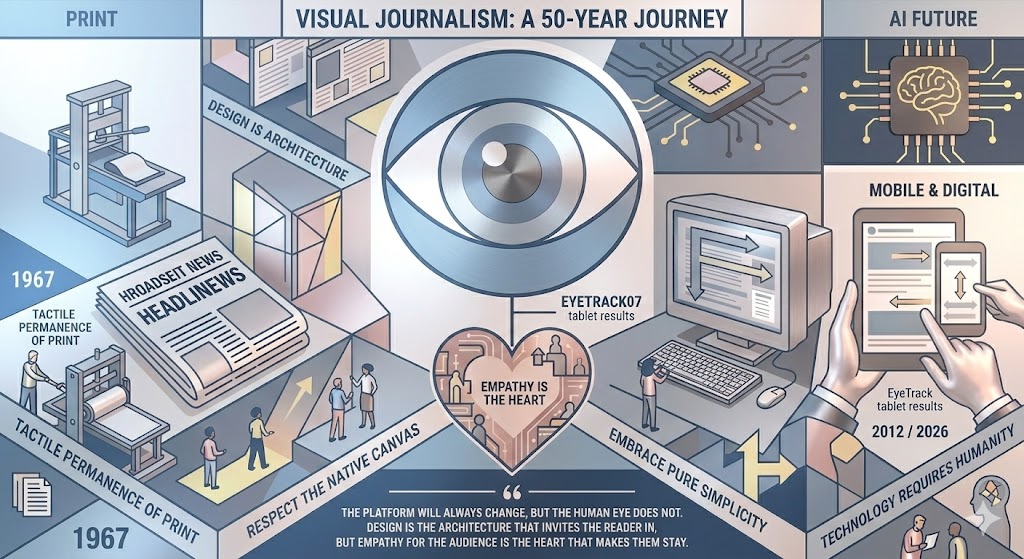
Illustration from GoogleGemini-Nano Banana/based on a Mario Garcia concept.
The question from the participant in the workshop was: “You have had a long career in this business and have written several books. Is there anything that remains intact in terms of your beliefs that are as applicable today as they were back then?”.
As I walked back to my hotel—a pleasant, leisurely stroll through an inviting park in central Düsseldorf—it was a perfectly sunny afternoon in late February that held optimistic aspirations for early spring. The question during the workshop made me do a quick mental review of my published books, trying to come up with at least one main takeaway from each that would still stand today.
Much to my surprise, there are several themes that have been constant in my long career in visual journalism and the media generally.
For five decades, the canvas of news and storytelling has been in a state of constant, thrilling upheaval. We have moved from the tactile permanence of ink on broadsheets to the glowing phosphors of broadcast screens, into the infinite scroll of the web, the intimate tap of the tablet, the vertical rhythm of the smartphone, and now, the generative frontier of AI.
I always remind my students that I have lived through six revolutions in the media. Indeed, there were typewriters when I started my career in 1967.
But through every revolution, the core mission has never wavered. Most importantly, the story—the content we create—still ranks as the single most important reason for everything else we do. That has not changed since I wrote my first story for my college newspaper.
The basics still hold today
This is what half a century at the intersection of journalism, design, and technology has taught me:
- Design is Architecture, Not Decoration: We are not here to merely make things pretty. We are information architects. Good design provides the structural framework that organizes chaos, establishes hierarchy, and makes the news accessible and effortless to navigate.
- Follow the Human Eye: Design must be rooted in reality and reader behavior, not just designer intuition. Visual entry points—the bold headline, the striking photo, the pull quote—are the undeniable hooks that pull a human mind into a narrative.
- Respect the Native Canvas: You cannot force the rules of the past onto the tools of the future. Every medium—whether a newspaper page, a web browser, an iPad, or a mobile screen—demands its own native storytelling rhythm. We must design for how the medium is used, not just how it looks.
- Embrace Pure Simplicity: The most complex design problems are solved through subtraction. True elegance and clarity are achieved when we strip away the clutter, allowing the core content to breathe and shine.
- Technology Requires Humanity: From the introduction of the first newsroom computers to the dawn of AI, technology is a collaborator, not a replacement. And as we guide newsrooms through these massive shifts, we must do so with heart. Empathy, active listening, and compassionate leadership are just as crucial as the design itself.
If there is one absolute truth that strings together 50 years of work, thousands of redesigns, and every book on my shelf, it is this:
“The platform will always change, but the human eye does not. Design is the architecture that invites the reader in, but empathy for the audience is the heart that makes them stay.”
What we learned from the Poynter EyeTrack studies
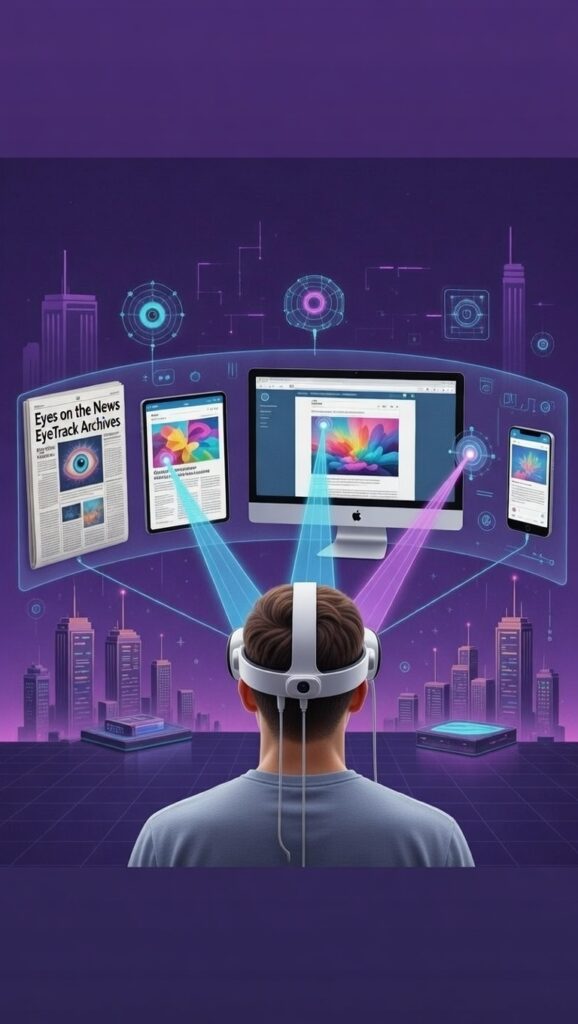
The beauty of the Poynter EyeTrack studies is that they provide designers with the necessary hard data to back up their design decisions. When we look at the numbers across the decades, they completely shatter the myth that technology ruined attention spans, proving instead that human behavior just adapted to new canvases.
Here is a breakdown of the most powerful statistics and quotes from the EyeTrack archives, perfectly aligned with my theme that a good story is essential, and the human eye does not change.
1. The Myth of the Short Attention Span (EyeTrack07) Perhaps the most powerful data comes from the 2007 study, which shattered the assumption that the internet was killing deep reading.
- The Golden Statistic: Online readers actually read more of a story than print readers. The study found that once an online reader selects a story, they finish an average of 77% of the text. By comparison, broadsheet print readers finished 62%, and tabloid readers finished 57%.
- The Takeaway Quote: “Readers select stories of particular interest and then read them thoroughly. And there’s a twist: The reading-deep phenomenon is even stronger online than in print. At a time when readers are assumed to have short attention spans… this qualifies as news.” — Rick Edmonds, Poynter (2007)
2. The Power of the Visual Entry Point (EyeTrack I & III) These studies proved my architectural theory of design: the platform changes how the eye enters, but the eye still desperately needs a guide. Regardless of what platform you are designing for, there must be a Center of Visual Interest, which is where the eye goes to first. Hierarchy through placement and type size is important.
- Print vs. Digital Entry: In print (EyeTrack 1991), dominant photographs and large headlines were the undeniable initial entry points. However, EyeTrack III (2004) revealed that on a computer screen, the eye behaves differently: it fixates first in the upper left of the page, hovering there before scanning left to right.
- The Architecture of Typography: EyeTrack III proved that size dictates behavior. Smaller type actually encourages focused, deep reading, while larger type promotes rapid scanning.
- The Takeaway Quote: “Smaller type encourages focused viewing behavior (that is, reading the words), while larger type promotes scanning… People typically scan down a list of headlines… On average, a headline has less than a second of a site visitor’s attention.” (2004)
3. The Need for Empathy and the “Lean-Back” Canvas (EyeTrack Tablet, 2012) As tablets emerged, our work with Poynter highlighted the deep physical and emotional connection readers have with their devices, proving that design must have empathy for the user’s environment.
- The Instinctual Touch: The 2012 study found that readers have an overwhelming, undeniable instinct to interact horizontally with tablets. 93% of users reading in landscape orientation instinctively swiped horizontally through photo galleries, proving that digital design must honor natural human touch, not fight it.
- Intimate vs. Detached: The research categorized readers by their physical behavior. 61% were “intimate readers” who constantly touched the screen and scrolled little by little, while others were “detached,” leaning back to consume a whole page before moving on.
What has not changed: What I said in 2012 still rings true today: “Storytelling is the one thing that has not changed, regardless of how many platforms we use to practice our craft. With a good story in hand, the rest becomes easy.” — Mario Garcia (2012)
Appendix: The Complete Poynter EyeTrack Archive
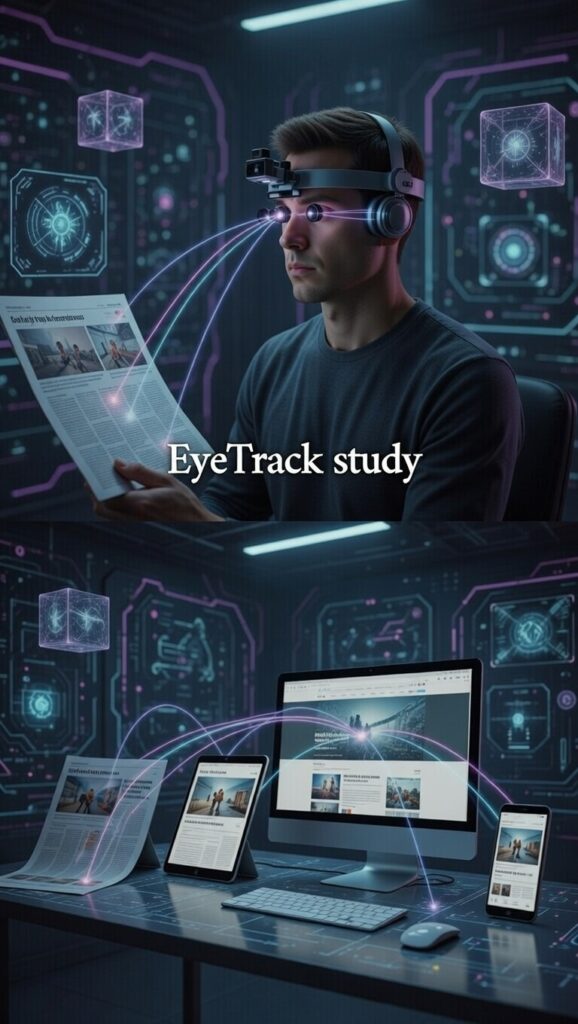
For those interested in diving deeper into the research that has guided our industry, here are the resources:
- Poynter’s EyeTrack Tag Archive: The master directory for all articles, research updates, and retrospectives: poynter.org/tag/eyetrack/
- EyeTrack I (1990-1991): Print & Color. While the original 1990 data was primarily published in my book with Dr. Pegie Stark, Eyes on the News, Poynter has a great retrospective piece detailing the methodology: Looking Back at EyeTrack (Published 2007)
- EyeTrack III (2003-2004): Online News Reading. Focused on how readers consumed early news websites: Eyetrack III: What News Websites Look Like Through Readers’ Eyes
- EyeTrack07 (2007): Print vs. Online. Directly compared broadsheet, tabloid, and online formats: EyeTracking the News: Story Packaging
- EyeTrack Tablet (2012): The iPad Era. Conducted by Sara Quinn and me, exploring the new physical relationship readers had with touchscreen news: New Poynter Eyetrack research reveals how people read news on tablets
Consulting with Heart

Consulting with Heart — my 17th book—is here! Ready to order. Thanks for making it already the #1 Hot New Release for Media & Communications Books at Amazon.com. Also available from Apple, Barnes & Noble, Target, Torchlight.
Written from my more than 200 diaries. Fueled by people I have met along the way in my journey through 122 countries, this book isn’t just about strategy. It is about my five-decade journey, 750+ projects and my role as an interpreter of dreams for my clients.
amazon.com/dp/1966629958; Apple Books – ebook
Workshop deals with the two big revolutions facing editors
For me, it is imperative that editors approach content creation thinking in terms of mobile first.
Mobile first involves the type of transformation where all content is prepared thinking from small to large platform. Thinking small platform does not mean that the reporter conceptualizing a story for mobile consumption should not think BIG. So, plan from small to large, but think big in terms of the story content and the visual assets that go with it.
While mobile first is still elusive to so many newsrooms around the planet, here we are, in 2024, faced with an even bigger challenge not just knocking at our doors, but already IN: Artificial Intelligence.
Transformation and a change of mentality to face these challenges is the first step. Training and education to tackle them with a sense of focus and direction is essential.
That’s where our Garcia Media workshops come in
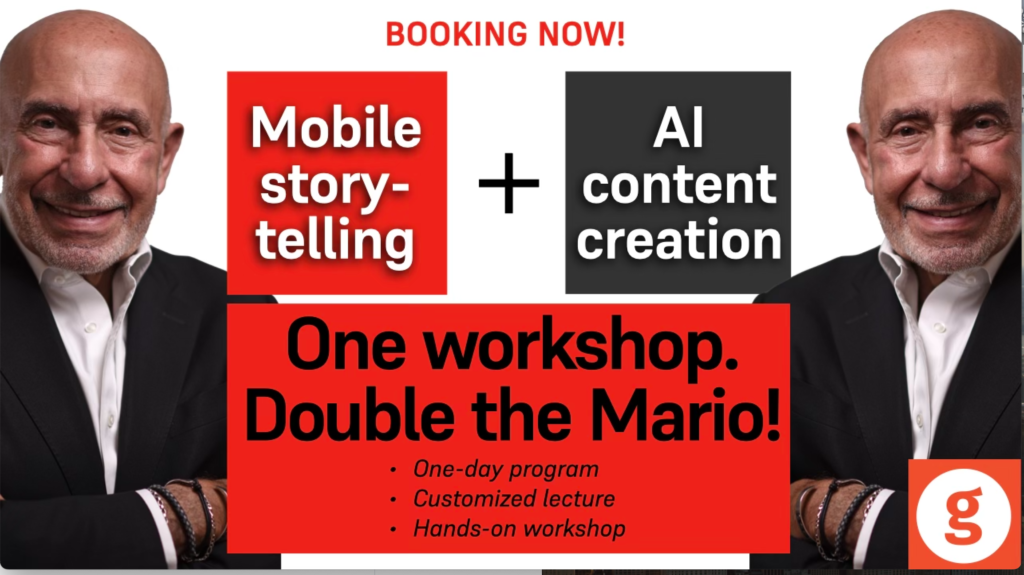
Our Garcia Media Mobile Storytelling workshops introduce your editorial team to the way we write, edit and design for mobile platforms. This one-day program includes a presentation and a hands-on workshop. We’ve added a new segment about AI for content creation.
Newsrooms around the planet have gone mobile-first after a Garcia Media workshop!
Our Garcia Media Mobile Storytelling workshops are proven to introduce your editorial team to the way we write, edit and design for mobile platforms. It is a one-day program that involves a presentation (where I summarize my Columbia University class content), and follow it with a hands on workshop.
For details, to customize, and to book: mario@garciamedia.com
How we use AI
Honored to be mentioned here:
https://www.newsroomrobots.com/p/how-10-news-industry-leaders-use
Order my AI book here:
https://thaneandprose.com/…/preorder-ai-what-to-expect…
TheMarioBlog post #4017