A response to Alan Hunter’s “The Foggy Future of AI News”-published via Linkedin June 12, 2026. You can read it here:
https://www.linkedin.com/pulse/foggy-future-ai-news-alan-hunter-r5tye
Alan Hunter is too honest a journalist to pretend he can see what he cannot see. That is precisely why his newsletter from Marseille, written in the afterglow of the WAN-IFRA World News Media Congress, stayed with me long after I left the south of France.
He quoted me — accurately, generously — and then admitted, with a smile he described in print, that he was “not any the wiser” about what I meant when I said we need to put the scent of the human into stories.
Alan, this one is for you. And for everyone else standing in that fog.
The Question Behind the Question
Alan’s piece is ostensibly about atomization — about whether the article form will survive, about payment models for snippets, about agentic subscriptions and the death of the homepage. These are real and urgent questions. But underneath all of them is a single, deeper anxiety:
If AI can assemble the news, what is left for us to do?
That is the fog. And it is thick precisely because we keep trying to answer it with technology, when the answer is anthropological.
What “The Scent of the Human” Actually Means
I have been a journalist and media designer for more than fifty years. I have watched the profession survive hot type, cold type, the internet, the smartphone, and now this. Each time, the obituaries were written early. Each time, what survived was not the format — it was the person behind the format.
“The scent of the human” is not a metaphor for sentiment or nostalgia. It is a description of something precise and irreplaceable.
It is the reporter who sat in the courtroom for six days and noticed, on the seventh, that the defendant’s hands stopped shaking. It is the foreign correspondent who understood that the silence after the speech was the real story. It is the editor who knew, at midnight, that the headline was technically accurate but emotionally false.
AI draws from the library of humanity. It can synthesize everything that has already been felt, written, and recorded. What it cannot do — what it will never do — is feel something for the first time and know that it matters.
That feeling, that judgment, that presence: that is the scent. And in a world where AI can produce a thousand competent versions of any story, the one that carries the scent of a human being who was actually there will be the one worth paying for.
The Six Revolutions, and Why This One Is Different
In Marseille I told the audience I had lived through six journalistic revolutions. Alan quoted this faithfully. But let me add the coda I didn’t fully articulate on stage.
Each of the previous revolutions — hot type to cold, typewriter to computer, black and white to color, the internet, mobile — changed how we told stories. The tools changed. The workflows changed. The deadlines changed.
This revolution is changing why we tell stories at all.
When the audience can get a personalized, algorithmically assembled summary of world events delivered to their phone in the format they prefer, at the moment they choose, without ever visiting a news brand — then the question is no longer “how do we publish?” The question is: “What do we offer that an algorithm cannot?”
The answer is the same one it has always been, dressed in new language: witness. The irreducible act of a human being paying attention on behalf of other human beings.
On Atoms and Articles
Alan wrestles beautifully with the atomization question. He cannot imagine how the atoms will cohere. Neither, frankly, can I — not yet. But I would push back gently on one thing.
The article is not sacred. It is a container that developed because of the constraints of print. We filled it with words the way we filled columns of lead type — because that was the shape the vessel required.
Mobile storytelling does not require that container. It requires intention: a journalist who knows what they are trying to make the reader feel, and chooses — consciously, creatively — which combination of text, image, audio, data, and video will produce that feeling most powerfully.
What we are still doing — and this is the 1957 I was talking about — is pouring new wine into old bottles. Not because the old bottle is better, but because we have not yet built the courage or the infrastructure to let it go.
The Fog Has a Shape
Alan closes with a warning I agree with entirely: the news industry should not leave the navigation of this road to the AI giants who may not have our best interests at heart.
He is right. But I would add: the fog is not an absence of visibility. The fog has a shape. And if you walk into it slowly, with your senses open, you begin to smell something.
You smell the story. You smell the source who is afraid. You smell the press release disguised as news. You smell the difference between what was said and what was meant.
That ability — to smell the story — is what we must protect, develop, and teach. It is not a nostalgic skill. It is the most advanced competitive advantage the journalism profession possesses in the age of artificial intelligence.
Alan, I hope the fog is a little less foggy now.
Consulting with Heart

Consulting with Heart — my 17th book—is here! Ready to order. Thanks for making it already the #1 Hot New Release for Media & Communications Books at Amazon.com. Also available from Apple, Barnes & Noble, Target, Torchlight.
Written from my more than 200 diaries. Fueled by people I have met along the way in my journey through 122 countries, this book isn’t just about strategy. It is about my five-decade journey, 750+ projects and my role as an interpreter of dreams for my clients.
amazon.com/dp/1966629958; Apple Books – ebook
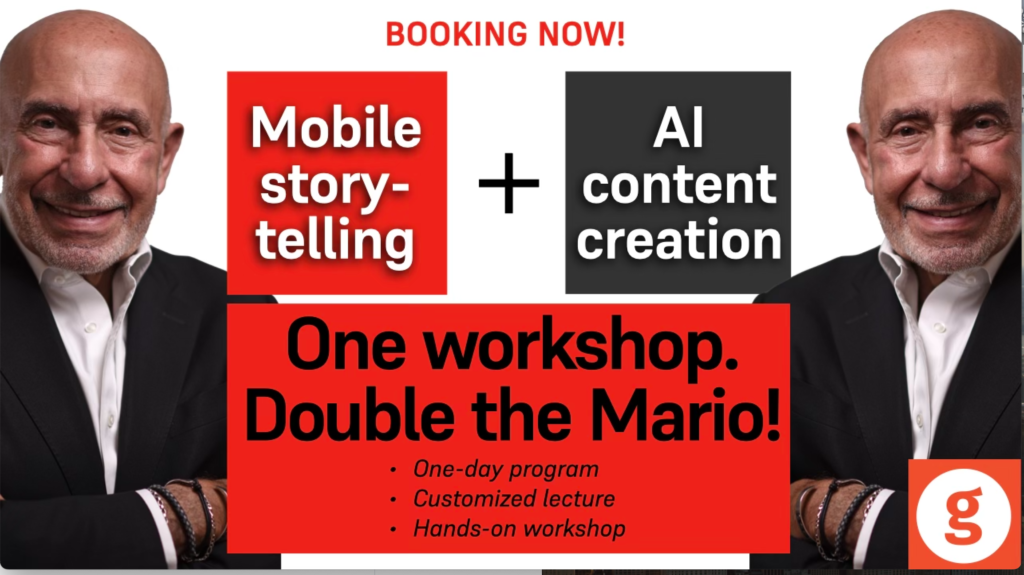
Workshop deals with the two big revolutions facing editors
For me, it is imperative that editors approach content creation thinking in terms of mobile first.
Mobile first involves the type of transformation where all content is prepared thinking from small to large platform. Thinking small platform does not mean that the reporter conceptualizing a story for mobile consumption should not think BIG. So, plan from small to large, but think big in terms of the story content and the visual assets that go with it.
While mobile first is still elusive to so many newsrooms around the planet, here we are, in 2024, faced with an even bigger challenge not just knocking at our doors, but already IN: Artificial Intelligence.
Transformation and a change of mentality to face these challenges is the first step. Training and education to tackle them with a sense of focus and direction is essential.
That’s where our Garcia Media workshops come in
Our Garcia Media Mobile Storytelling workshops introduce your editorial team to the way we write, edit and design for mobile platforms. This one-day program includes a presentation and a hands-on workshop. We’ve added a new segment about AI for content creation.
Newsrooms around the planet have gone mobile-first after a Garcia Media workshop!
Our Garcia Media Mobile Storytelling workshops are proven to introduce your editorial team to the way we write, edit and design for mobile platforms. It is a one-day program that involves a presentation (where I summarize my Columbia University class content), and follow it with a hands on workshop.
For details, to customize, and to book: mario@garciamedia.com
How we use AI
Honored to be mentioned here:
https://www.newsroomrobots.com/p/how-10-news-industry-leaders-use
Order my AI book here:
https://thaneandprose.com/…/preorder-ai-what-to-expect…
TheMarioBlog post #4022