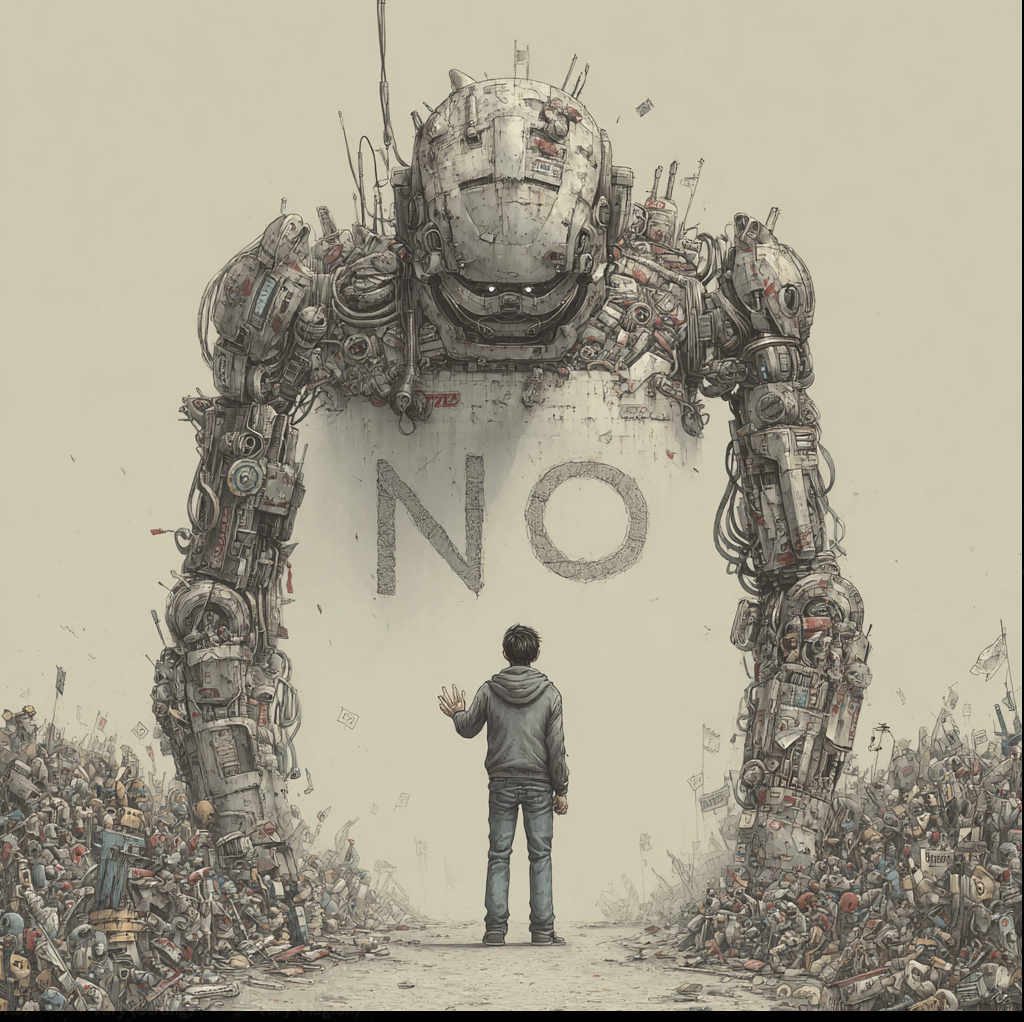
Illustration by Midjourney, inspired by a Mario Garcia prompted idea.
I have just returned from a European tour of three countries, and what took me there was not pure tourism. Not at all. I was there to conduct workshops about AI and the scent of the human at the controls of the machines. To be at the controls, humans need to become experts in two areas: the art of the prompt, and the courage of the Veto Power.
The message was the same in the Netherlands, Germany, and France: to get the best out of a machine, we must be less like one.
The art of prompting
We must stop being passengers and start being captains — in control. Speak the language of humans, not robots. When prompting, write what I call scented prompts, because through them you bring yourself fully to the AI, and the machine rises to meet you. Also, learn to exercise your Veto Power to respond to machine input that does not feel right. Your first contact with AI is via prompting, so let’s review prompt strategies:
A cold prompt reads like this:
“Give me a strategy for a new luxury product launch.”
A scented prompt for the same brief reads like this:
“I don’t want a ‘beautiful’ campaign. I want the Scent of the Rebellion. It should smell like blue glitter on a rainy pavement. Reject the statistically safe path. Give me the weird, specific thing that makes this resonate with one person, not the masses.”
The unscented prompt invites a Wall of Gray response — factual but flat. The scented prompt is a collaboration. The human brings biography, scars, memories, messy emotions, lived witness, and imperfections. The machine brings precision. But the human brings meaning.
The art of saying NO
Even more important, the human is at the controls when he exercises his Veto Power — the ability to say NO to the machine.
The Veto Power is not a technical function. There is no button labeled “reject” in the soul of a good editor, a thoughtful journalist, or a seasoned communicator. It is something more organic — a reflex born of experience, taste, and the accumulated wisdom of a life lived in full. It is the moment when the human looks at what the machine has produced and says, quietly but firmly: Not this. Not yet. Not quite.
The reasons for exercising that veto are as varied as the humans who hold it.

Illustration by Midjourney
THE FACTUAL VETO
Sometimes the AI output is factually wrong — a date misremembered, a statistic inflated, a quote that never quite existed. That is the easiest veto, the one requiring no apology. The machine hallucinated. You caught it. You say no.
But the more interesting vetoes — the ones that separate true captains from passive passengers — have nothing to do with facts at all.
THE TONAL VETO
Sometimes you veto because the tone is off. The machine produced something technically correct but emotionally deaf. It sounds like a press release written by an algorithm for an audience of algorithms. The words are there. The music is not.
THE SAFETY VETO
Sometimes you veto because it is too safe. The AI gravitates toward the middle — the statistically probable, the culturally inoffensive, the professionally bland. It gives you beige when you asked for crimson. The Wall of Gray has done its work, and you must dismantle it.
THE TIMING VETO
Sometimes you veto because it is too fast. The machine leapt to conclusions before the question was fully formed. It answered the surface of what you asked and missed the depth of what you meant. Good journalism — good communication of any kind — knows that the right answer to the wrong question is still the wrong answer.
THE GUT VETO
Sometimes you veto because something in your gut simply resists. This is perhaps the most important veto of all, and the hardest to justify in a meeting room or an editorial debrief. This is the “something doesn’t feel right” veto. You cannot point to the paragraph that fails. You cannot cite the rule that was broken. You only know — with the certainty of someone who has spent decades reading the world — that this piece does not yet carry the weight of truth. It is accurate without being honest. It is complete without being real. You know in your gut that this is not something a human who has been a witness to life would write or say.
That gut veto is your biography speaking. Your scar tissue. Your professional intuitions. Your years of watching what lands and what merely arrives. The machine has no scar tissue. It has no biography. It can produce the form of experience but not the feeling of it. Only you can supply that — and only you can recognize when it is missing.
THE ETHICAL VETO
There is also the ethical veto. The moment when the AI produces something legal, publishable, even clever — but wrong in a way that has nothing to do with accuracy. It stereotypes without meaning to. It simplifies what deserves complexity. It takes a shortcut across someone’s dignity. You notice. You stop. You say no — not because a policy told you to, but because you are a human being with a conscience, and you have not outsourced that yet. You have had interactions, the machine has not.
THE AESTHETIC VETO
There is the aesthetic veto — perhaps the most personal of all. The machine gave you perfectly serviceable prose, but it does not sound like you. It does not carry your rhythm, your particular way of entering a subject, the specific music of your voice. You have spent a career developing that voice, through a thousand late nights and ten thousand revisions. You are not about to let a machine flatten it into something generic, however smooth. You veto not out of vanity, but out of fidelity — to your craft, your readers, your truth.
THE TASTE VETO
And sometimes, you say NO simply because the output shows no taste. No instinct for what is surprising, elegant, or alive. The machine optimized. It did not choose. And choosing — with all the risk and personality that choosing entails — is still a fundamentally human act.
This is what it means to be at the controls. Not to distrust the machine, but to remain more than it. To bring to every collaboration the one thing artificial intelligence cannot manufacture: genuine human judgment, earned the hard way, over time, in the world.
The future belongs to the collaboration of human and machine. But for that collaboration to succeed, we must master two things equally: the art of the scented prompt, and the courage of the veto. The machine will optimize precision. The human optimizes meaning. And the Veto Power is the ultimate proof that the human remains — always, irreplaceably — at the controls.
Consulting with Heart

Consulting with Heart — my 17th book—is here! Ready to order. Thanks for making it already the #1 Hot New Release for Media & Communications Books at Amazon.com. Also available from Apple, Barnes & Noble, Target, Torchlight.
Written from my more than 200 diaries. Fueled by people I have met along the way in my journey through 122 countries, this book isn’t just about strategy. It is about my five-decade journey, 750+ projects and my role as an interpreter of dreams for my clients.
amazon.com/dp/1966629958; Apple Books – ebook
Workshop deals with the two big revolutions facing editors
For me, it is imperative that editors approach content creation thinking in terms of mobile first.
Mobile first involves the type of transformation where all content is prepared thinking from small to large platform. Thinking small platform does not mean that the reporter conceptualizing a story for mobile consumption should not think BIG. So, plan from small to large, but think big in terms of the story content and the visual assets that go with it.
While mobile first is still elusive to so many newsrooms around the planet, here we are, in 2024, faced with an even bigger challenge not just knocking at our doors, but already IN: Artificial Intelligence.
Transformation and a change of mentality to face these challenges is the first step. Training and education to tackle them with a sense of focus and direction is essential.
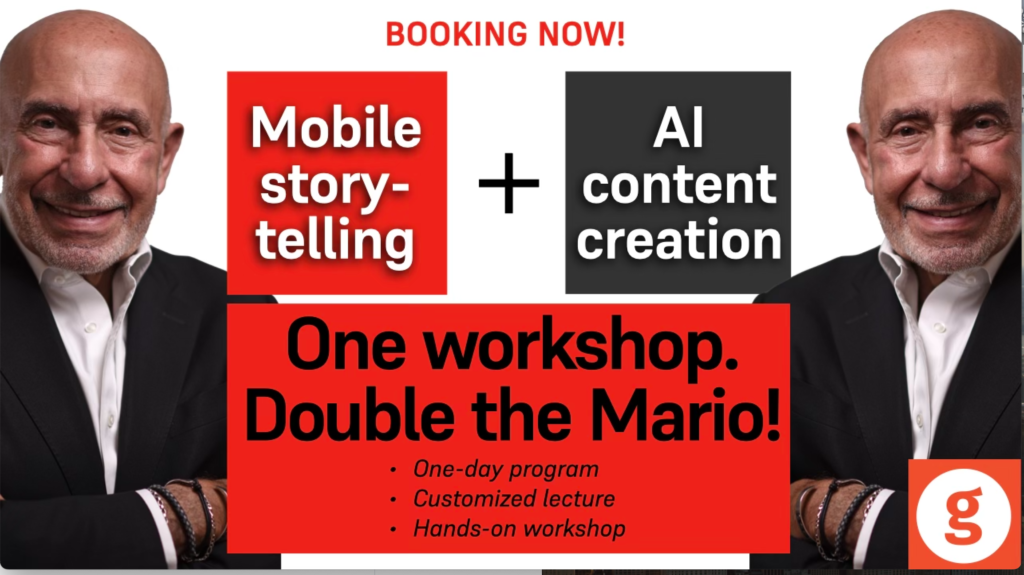
That’s where our Garcia Media workshops come in
Our Garcia Media Mobile Storytelling workshops introduce your editorial team to the way we write, edit and design for mobile platforms. This one-day program includes a presentation and a hands-on workshop. We’ve added a new segment about AI for content creation.
Newsrooms around the planet have gone mobile-first after a Garcia Media workshop!
Our Garcia Media Mobile Storytelling workshops are proven to introduce your editorial team to the way we write, edit and design for mobile platforms. It is a one-day program that involves a presentation (where I summarize my Columbia University class content), and follow it with a hands on workshop.
For details, to customize, and to book: mario@garciamedia.com
How we use AI
Honored to be mentioned here:
https://www.newsroomrobots.com/p/how-10-news-industry-leaders-use
Order my AI book here:
https://thaneandprose.com/…/preorder-ai-what-to-expect…
TheMarioBlog post #4021