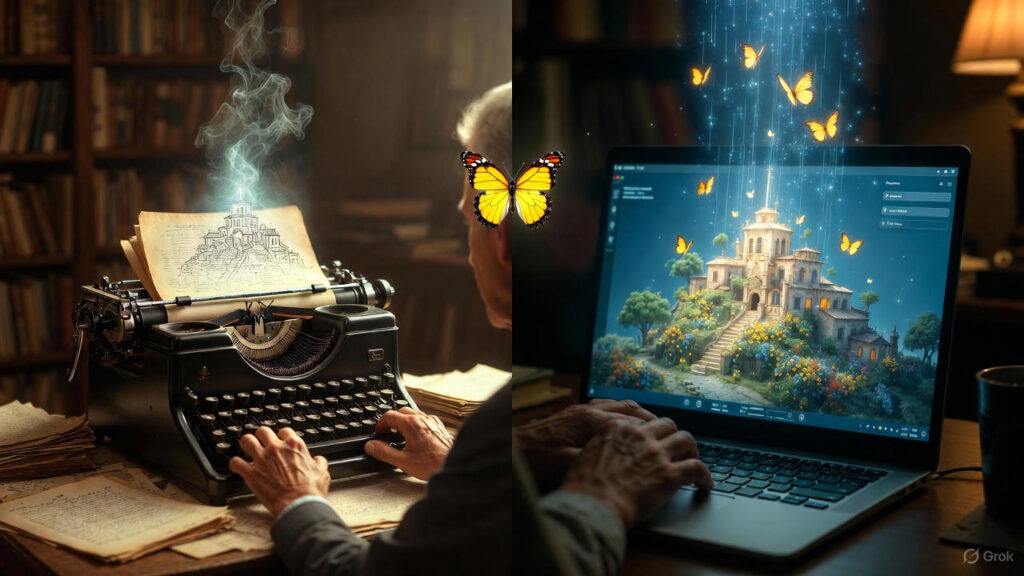
(Author’s note: This week I am in Lysekloster, in southwestern Norway, a quiet, picturesque spot whose main claim to fame is the atmospheric medieval Lyse Abbey, dedicated to the VirginMary. It is peaceful and serene here, and a dust of white snow covers everything within view. The ambience leads to meditative thinking, especially as I am reading a book titled, Christopher Isherwood Inside Out, where there is a reference to Isherwood’s creation of a fictional place, Mortmer. As someone who is enthusiastically dealing with AI issues everyday, I started thinking of how humans have invented people and places long before it was easy to do it with the help of AI.)
Creating that other you
I was in Chicago recently addressing a room full of U.S. Catholic bishops—an audience rather different from my usual crowd of media executives and newsroom designers. The topic of my presentation was an introduction to artificial intelligence. During a break, a young priest pulled me aside. He was already deep into artificial intelligence and eager to go deeper.
At first we talked about the obvious: using AI to research scripture, patristic texts, or lectionary themes for better sermons. Useful, but tame. Then he revealed his real ambition: “I want to train an AI alter ego that knows my theology, my preaching style, my spiritual instincts—everything. A digital twin I can bounce ideas off at 3 a.m.”
We kept talking long after the sessions ended, eventually landing side-by-side at the closing banquet. An older priest at our table, who had been listening, finally leaned in:
“Young man, if you need someone to test your ideas, why not find a real friend—a flesh-and-blood human being?”
The young priest thought for a second and replied, “That makes perfect sense… except no human I know has the entire Catholic tradition instantly searchable in his head.”
I mentioned that I, too, have created an alter persona using AI. Because I have introduced this AI friend to my writing and ideas, I can come to it regardless of what time zone I am in at the moment and establish a dialog that leads to good information, speeds up the research process and often surprises me with its insights. I have given my friend a name my mother used for me when I was a child.
We laugh about AI “hallucinating” fake people and nonexistent cities today, as if this were some disturbing new phenomenon. It isn’t. Human beings have been fabricating companions and entire civilizations since we first started telling stories around the fire. I remember hearing people use the word “hallucinating” as related to Gabriel Garcia Marquez‘ narrative in One Hundred Years of Solitude. Many in front of a Salvador Dali painting have thought the same.
Remember the imaginary friend from childhood? Most of us had one. Literature simply scaled the practice.
- Plato gave us Atlantis (c. 360 BCE), a drowned superpower meant to teach hubris.
- Homer conjured the Phaeacians, the Lotus-Eaters, and the underworld of Hades.
- Thomas More invented the original Utopia (1516)—the “no-place” that named the entire genre.
- Swift sent Gulliver to Lilliput, Brobdingnag, and the flying island of Laputa.
- Samuel Taylor Coleridge dreamed up Xanadu in a laudanum haze.
The Latin American magical realists of the 20th century turned fictional geography into high art:
- Gabriel García Márquez built Macondo, the rain-soaked, insomnia-plagued town where yellow flowers fall from the sky and Remedios the Beauty ascends bodily to heaven.
- Juan Rulfo, of Mexico, dragged us to the ghost town of Comala in Pedro Páramo—already dead when the narrator arrives.
- Juan Carlos Onetti of Uruguay brooded over the decaying river port of Santa María.
None of these places exist on any map, yet millions of us have walked their streets in our minds.
AI augments, not replace the scent of the human
What AI changes is not the impulse—it accelerates and democratizes it. Where García Márquez spent eighteen months locked in a room birthing Macondo, today a careful prompt engineer can spin up a thousand plausible Macondos before breakfast. The difference is velocity and access, not essence.
The AI doesn’t replace the “human scent” that made Macondo unforgettable—the banana-company massacre, the smell of damp earth, the insomnia that made everyone remember everything. But a skilled human can now use AI the way a master painter once used apprentices to grind pigments or stretch canvas: to handle the mechanical load so the artist can focus on soul.
The young priest’s digital twin will never replace late-night conversations with a real mentor over coffee. Just like my AI friend has not replaced the friends I communicate with daily–whose friendship and contributions to make my life richer I find precious. But it can be a tireless sparring partner, a living concordance, an imagination on demand.
We stand at the same threshold our ancestors did when the printing press arrived, or when photography was born, or when the word-processor killed the typewriter. Every leap in tool-making looks, at first, like a threat to the human act of creation. In reality it is an invitation.
With artificial intelligence taking flight in our brains, it is much easier today to create entirely fictitious people, alternate identities. However, there’s indeed nothing fundamentally new about such inventions. Human imagination has been doing this for millennia, long before digital technology or AI entered the picture.
Garcia Marquez created Macondo for One Hundred Years of Solitude . I picture here, via a Midjourney-created video illustration, how Garcia Marquez could have created Macondo with the help of the friendly robot. On the screen, his creation as he describes in his masterpiece novel, a rain of tiny yellow flowers falling from the sky in Macondo after the death of José Arcadio Buendía. The flowers fell so thickly that they covered the streets and had to be cleared away with shovels for a funeral procession to pass.
Christopher Isherwood, along with his lifelong friend Edward Upward, created Mortmer, an imaginary English village as related in his fictional autobiography, Lions and Shadows (1938).
I am not saying that AI can gives us a Macondo with the vivid detail and the scent of the human writer that Garcia Marquez brought to it. However, with a solid prompt from the human who has visualized a Macondo in his head, AI can augment the content, iterate on it. Perhaps even bring layers that enhance the human creation.
Whether that’s ultimately enriching or overwhelming for human creativity remains one of the most fascinating open questions of our era. Indeed, it is a question that is always present as I conduct AI workshops around the planet.
It is no wonder that I often ponder how a Garcia Marquez, a Salvador Dali or an Oscar Wilde would utilize artificial intelligence–or if they would.
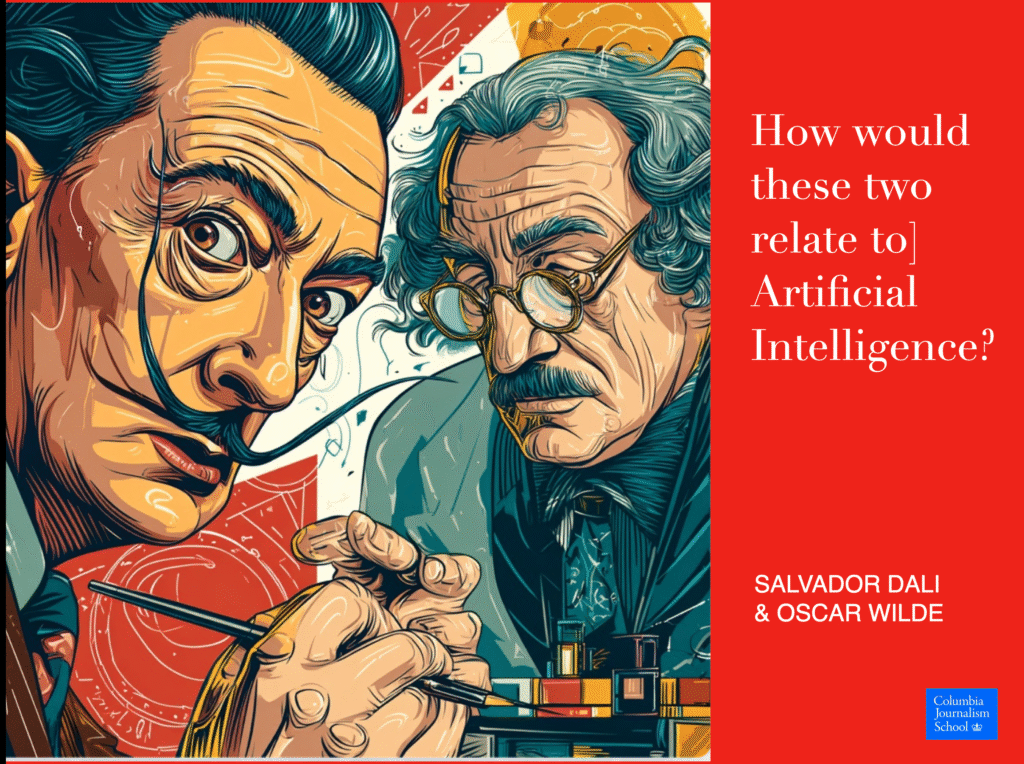
Human intent is the driving force behind meaningful creative work in the AI era. I maintain strong creative possibilities exist combining human sent with the machine power of AI.
The next Macondo, Atlantis, or Utopia is waiting—and for the first time in history, almost anyone with imagination can help build it.
No better time to be a storyteller, a mythmaker, a creator of worlds.
My new book is here: Consulting with Heart (2025)

Consulting with Heart — my 17th book—is here! Ready to order. Thanks for making it already the #1 Hot New Release for Media & Communications Books at Amazon.com. Also available from Apple, Barnes & Noble, Target, Torchlight.
Written from my more than 200 diaries. Fueled by people I have met along the way in my journey through 122 countries,
this book isn’t just about strategy. It is about my five-decade journey, 750+ projects and my role as an interpreter of dreams for my clients.
amazon.com/dp/1966629958; Apple Books – ebook
https://books.apple.com/us/book/consulting-with-heart-the-power-of-passion/id6754785243
Highlight/Chapter 3: Our mission is clear: We are the chaperones of change. Our clients
look to us not just for solutions but for the courage to embrace the new
and different. Clients have nightmares of what they’re afraid will happen.
Consultants have to replace those with the dream and bring the dream
to reality. Being a change agent demands a unique blend of skills such as
a deep understanding of human psychology, an ability to communicate
effectively, and an unwavering commitment to the client’s goals.

Workshop deals with the two big revolutions facing editors
For me, it is imperative that editors approach content creation thinking in terms of mobile first.
Mobile first involves the type of transformation where all content is prepared thinking from small to large platform. Thinking small platform does not mean that the reporter conceptualizing a story for mobile consumption should not think BIG. So, plan from small to large, but think big in terms of the story content and the visual assets that go with it.
While mobile first is still elusive to so many newsrooms around the planet, here we are, in 2024, faced with an even bigger challenge not just knocking at our doors, but already IN: Artificial Intelligence.
Transformation and a change of mentality to face these challenges is the first step. Training and education to tackle them with a sense of focus and direction is essential.
That’s where our Garcia Media workshops come in
Our Garcia Media Mobile Storytelling workshops introduce your editorial team to the way we write, edit and design for mobile platforms. This one-day program includes a presentation and a hands-on workshop. We’ve added a new segment about AI for content creation.
Newsrooms around the planet have gone mobile-first after a Garcia Media workshop!
Our Garcia Media Mobile Storytelling workshops are proven to introduce your editorial team to the way we write, edit and design for mobile platforms. It is a one-day program that involves a presentation (where I summarize my Columbia University class content), and follow it with a hands on workshop.
For details, to customize, and to book: mario@garciamedia.com
How we use AI
Honored to be mentioned here:
https://www.newsroomrobots.com/p/how-10-news-industry-leaders-use
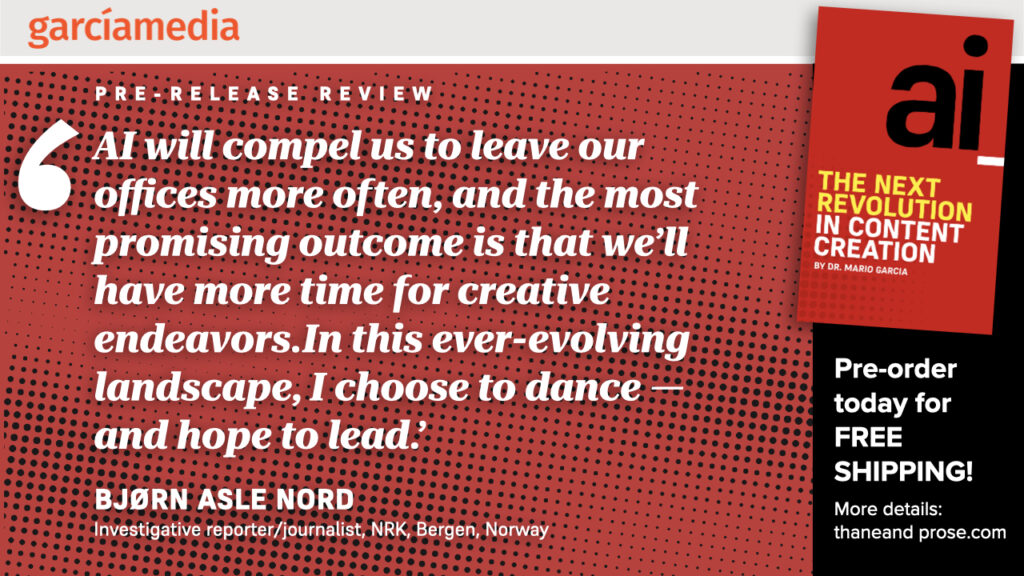
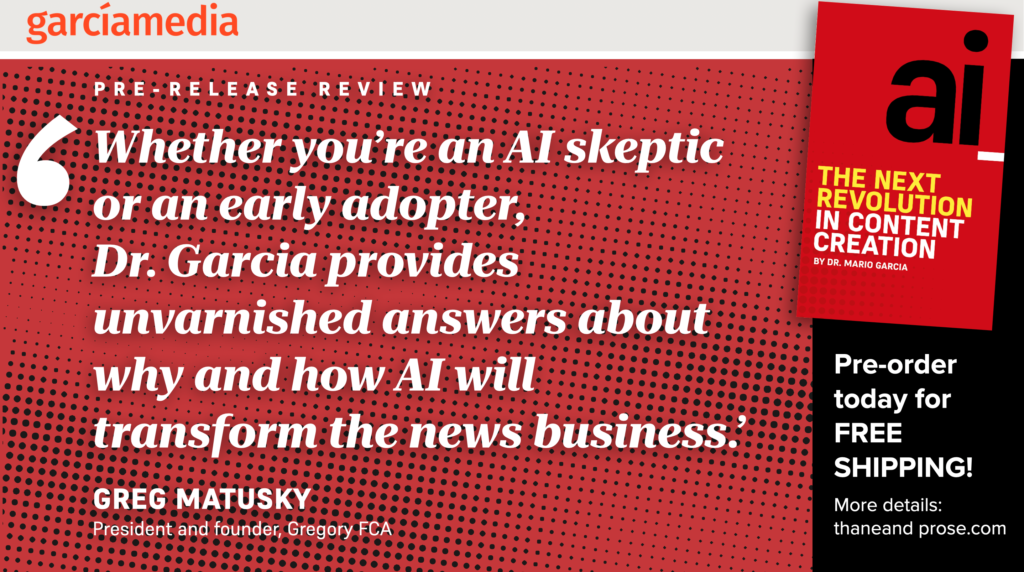
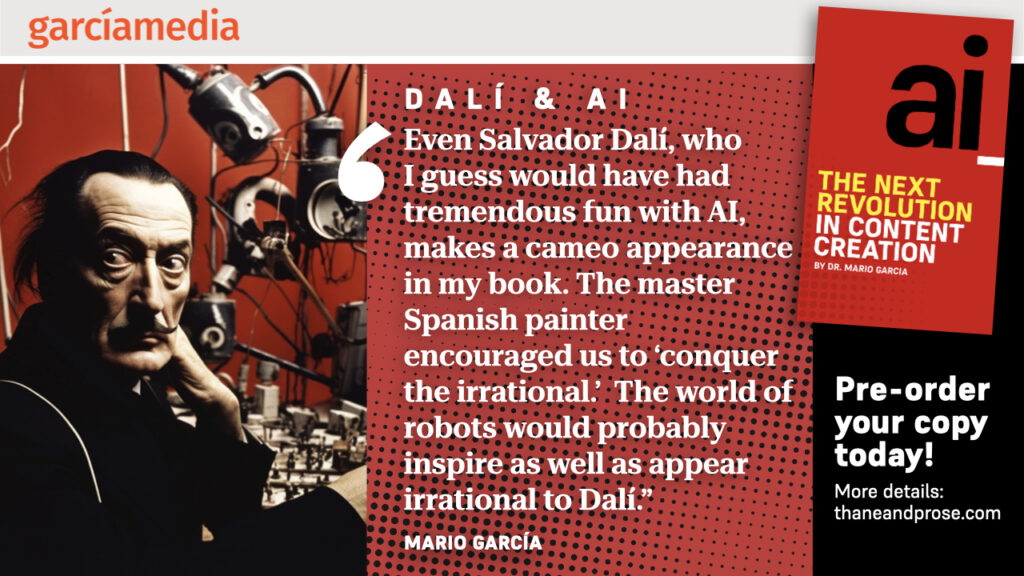
Order my AI book here:
https://thaneandprose.com/…/preorder-ai-what-to-expect…
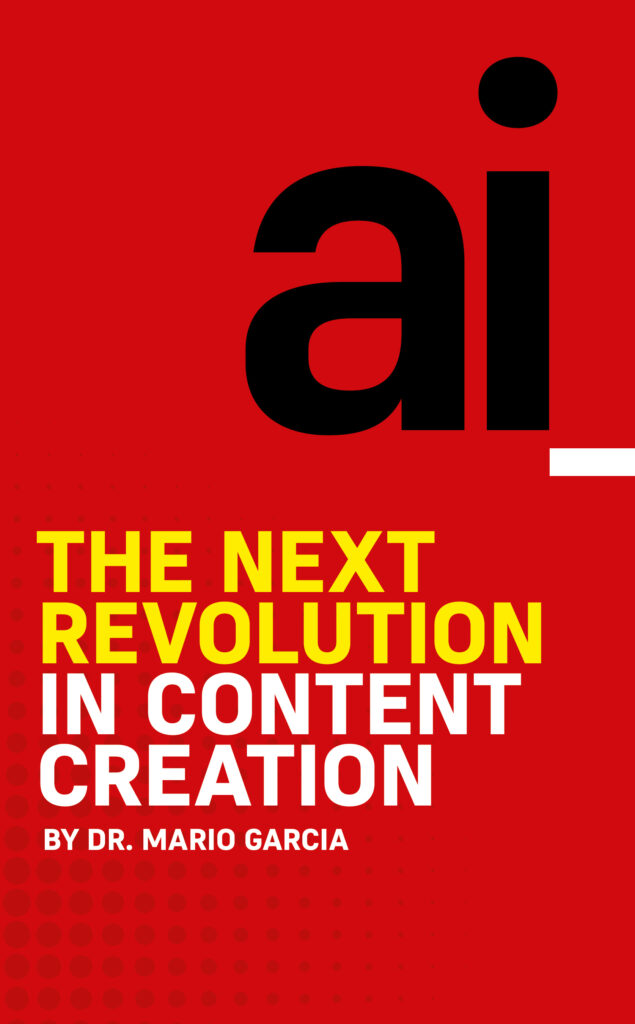
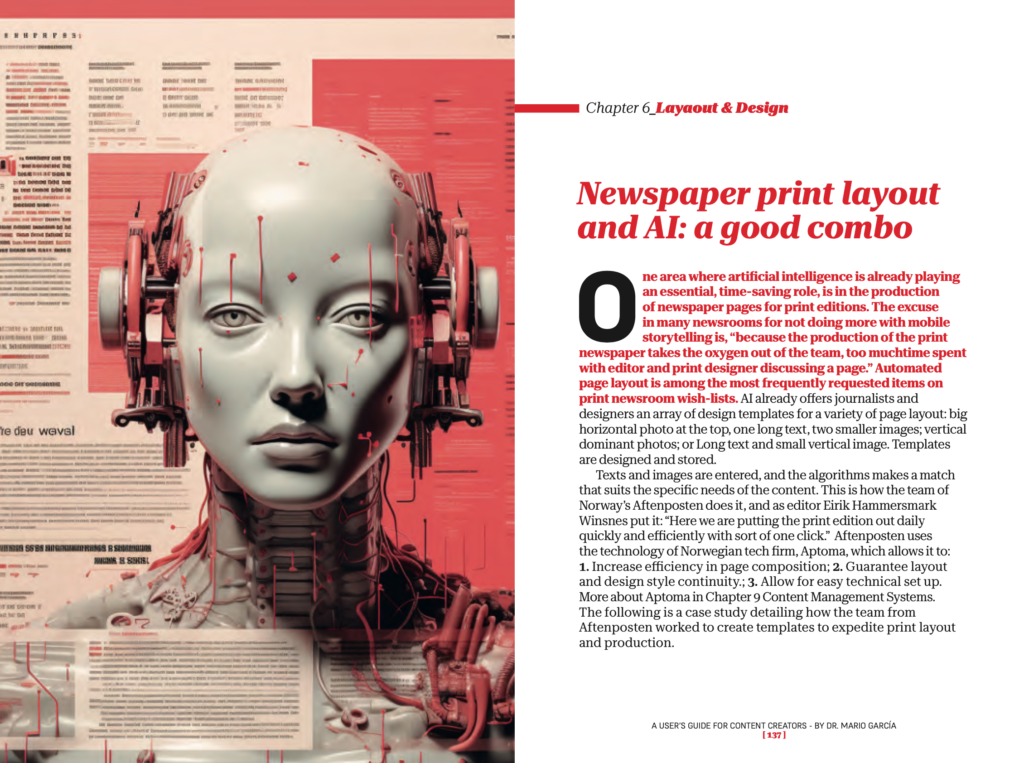
Here is a chance to pre-order my new book about Artificial Intelligence and content creation. The first 25 copies sold will be signed! Order here:
https://thaneandprose.com/…/preorder-ai-what-to-expect…
Reviews for AI book:

Did you read The Story yet?
I urge you to consult my latest book, The Story, a trilogy full of tips and explanations about mobile storytelling, which represents the latest genre for journalists to explore. See information below:
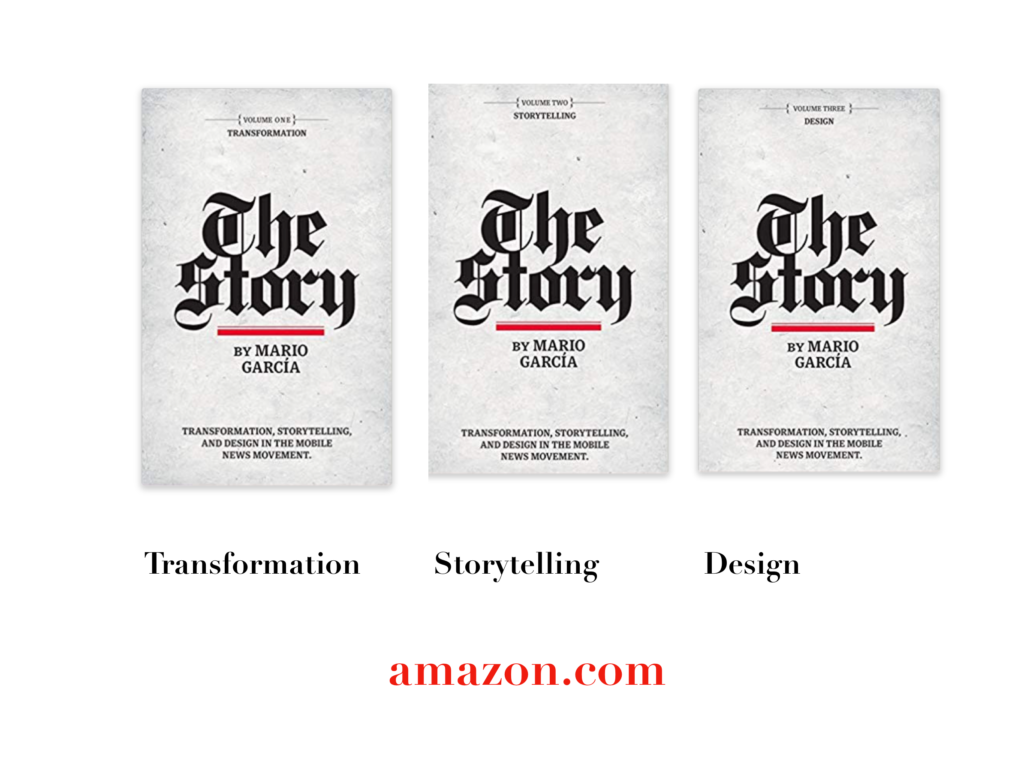
The full trilogy of The Story now available–3 books to guide you through a mobile first strategy. Whether you’re a reporter, editor, designer, publisher, corporate communicator, The Story is for you! https://amazon
Volume 1: Transformation
https://books.apple.com/us/book/the-story-volume-i/id1480169411
Volume Two: Storytelling
https://books.apple.com/us/book/the-story-volume-ii/id1484581220
Volume Three: Design
https://books.apple.com/us/book/the-story-volume-iii/id1497049918
Order the print edition of The Story, from Amazon, here:
TheMarioBlog post #4010