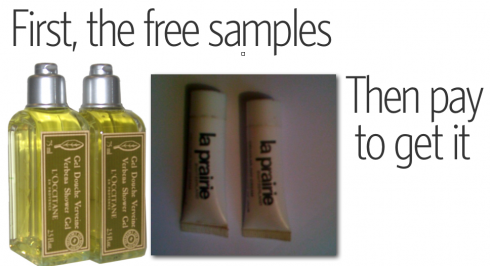
Perhaps newspapers need to follow the marketing strategy of cosmetic firms: First, free samples to hook us; then one must buy the product.
Rumors abound that some large U.S. dailies ma start charging for their online content, and just this week, Newsday, the Long Island, New York, daily confirmed that it will start charging for online use.
We reported about that in this blog: https://www.garciamedia.com/blog/articles/information_in_newspapers_has_a_value_start_charging_for_it_online
Now, Financial Times deputy editor Martin Dickson has told the Press Gazette, of the UK, that in his view, newspapers may have to charge readers for online content as their business model
“is not looking healthy”—-which could be the understatement of the month. His newspaper, the FT, is one of the few papers to charge for some online content and its online subscriptions have risen nine per cent year on year to 109,609.
Recent figures from the FT show that digital revenues represented 67 per cent of FT Group revenue last year, up from 28 per cent in 2000.
At a different level, the regional daily, The Irish News of Northern Ireland, which is one of the few to charge for online content, was the only regional newspaper to paid-for circulation in the second half of 2008.
This is, indeed, very positive news amidst a barrage of worsening news for newspapers. My hope is that stories such as these will make publishers and editors realize that the answer to many of their current economic woes may be as close as having a serious discussion about charging for online content.
Martin Dickson, the FT’s deputy editor since 2005, said other papers might have to copy their model – though not yet.
We disagree. We believe that the sooner newspapers begin the process, the better. Time, I am afraid, is not on the side of newspaper companies. Quick action is the answer.
A blogger offers tips to newspapers
Perhaps one of the most thought-provoking arguments I have read for newspapers to charge for their content are found in Alan Mutter’s blog (http://tinyurl.com/b7ndnl).
Here is a highlight of Alan’s blog:
If the news media don’t start getting paid for at least a portion of what they produce, some outlets simply aren’t going to be around to provide it. It’s already too late to save the Rocky Mountain News and probably too late to save the Seattle Post-Intelligencer and Tucson Citizen, which each face shutdown unless last-minute buyers emerge to rescue them.
So, free is not a business model that will support journalism produced by professional news organizations.
Review your inventory of offerings
I maintain that this is a discussion that MUST be taking place already, with a sound and realistic debate of the pros and cons about charging for content that has already been offered for free.
First, every newspaper should make an inventory of what it offers, selecting those items that readers may be willing to pay for. Each newspaper I know has a specialty, something that no other medium covers. In the case of regional newspapers, it is the local news and all that comes with it.
For national newspapers, it is the scope of analysis/opinion/investigative journalism that may offer the bait.
One thing is for sure, newspapers have assets to offer to readers and to charge for. But, before they can sell it effectively to their audience, they must believe that what they have is worth it—-starting with their brand. It stands for something. It means something to generation of readers. No reason why it should not continue to matter.
Of course, some of the newspaper’s website will always be for free, but lots of it will be charged for.
How cosmetic firms do it
Sort of like the marketing techniques of such commercial firms as La Prairie, the high-end Swiss cosmetic brand. It manages to get small samples of its line of products on the amenity kits given away to First and Business Class passengers by the world’s best airlines. You sample the moisturizer, you get hooked, you run to the store to get your (very expensive) skin caviar. You started with the free sample. You applied two drops to your forehead. You liked it. You bought it.
Perhaps this is a far fetched analogy, but one that has also worked for another brand, L’Occitane En Province—-its small shampoo and shower gels are now the standard for hotels worldwide. You liked the smell of that shower gel? Well, there is that L’Occitane store right at the airport before you take off.
We wish to continue this dialog, and to hear your comments about this timely—-and ever more urgently important—-topic.
Go here
http://tinyurl.com/arandf
Cutting through the visual clutter: Does your homepage pass the test?
Visual clutter happens most on high-content sites that lack organization in their design. It’s often overlooked or ignored and the result is a poor user experience, missed stories or information and a very short time on the web site. A visual segmentation test shows you exactly what’s wrong with the organization of your site and offers the opportunity to reorganize and create a design that keeps your users on your site longer and keeps them coming back. In this post, Mario describes the organization process and offers advice for avoiding clutter on your homepage. Here’s a sampling from the post:
A cursory look at most news sites and it becomes very obvious, regardless of how good the content, things are hard to find. Often, users don’t even know where to start. It’s as if everything has been dumped onto a page, crammed “above the scroll,” and left to the users to get their machetes out and make their way through the visual clutter. Users don’t want to have to work that hard. They’re too busy.
The tendency is to organize by subject matter or topic. And that works for building an information architecture or site map, but visually it’s better to organize by function. Nielsen’s advice works here—what are the main reasons users come to your site? For a news site the answers are normally to get news, to look for a job, to read columns, to share, to look at photos, to find out what’s going on for the weekend, etc. These are motivations more than categories and should be the basis for how the site should be organized visually.
For the rest of the article go here:
http://garciainteractive.com/blog/view/33/
:
To read TheRodrigoFino blog, in Spanish, go:
https://garciamedia.com/latinamerica/blog/
TheMarioBlog posting #205