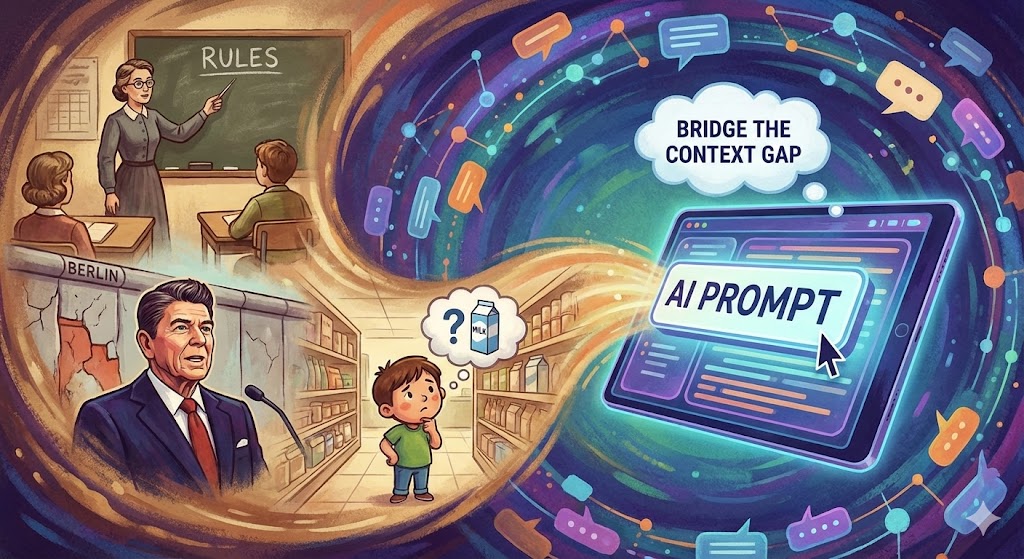
Today, we spend a staggering amount of time obsessed with “Prompt Engineering”—that mix of science and art required to communicate with our essential AI bots. It’s become the new must-have skill, the secret handshake of the digital age, and a language in which we all suddenly need to be fluent.
But the more I dig into prompt engineering for my workshops, the more I realize this isn’t a 21st-century invention. We have been dealing with prompts all our lives. Prompting is, and always has been, the fundamental unit of human cooperation.
My old high school teacher, Mrs. Earle, was a master “prompt engineer” long before Silicon Valley. She was setting system instructions when she glared at the class and said: “When I speak, you keep your hands under your desk!” She was setting a clear constraint to achieve a specific output: silence and attention.
Historically, landmark moments have hinged on a perfectly timed prompt. Think of President Reagan at the Brandenburg Gate on June 12, 1987, issuing a direct command not just to a man, but to a geopolitical system: “Mr. Gorbachev, tear down this wall!”
We have always been prompt engineers. We’ve just been engineering very unreliable processors: other humans.
The Context Gap: Why Humans Are Hard to Prompt
If prompting is so old, why does it feel so new? Because, historically, humans have been terrible at it.
We rely heavily on implicit knowledge—the lazy assumption that the other person can read our minds or perfectly share our context. Consider the classic newspaper newsroom. An editor has a vivid vision for a story and prompts a reporter: “Give me 800 words on the spirit of the city. Make it punchy.” But when the story appears, it’s nothing like what the editor envisioned. Why? Because the reporter’s “latent space”—their ego, their personal style, their deadline fatigue—overrode the editor’s intent.
We see this in our personal lives, too. Remember when your mother sent you to the corner store for “milk,” and you returned with chocolate milk because they were out of 2%? You didn’t fail; you just “hallucinated” a solution to a vague prompt. Human communication is messy. A verbal prompt given around the water cooler drifts and changes the moment it leaves your mouth.
From the vague to the specific: take a look
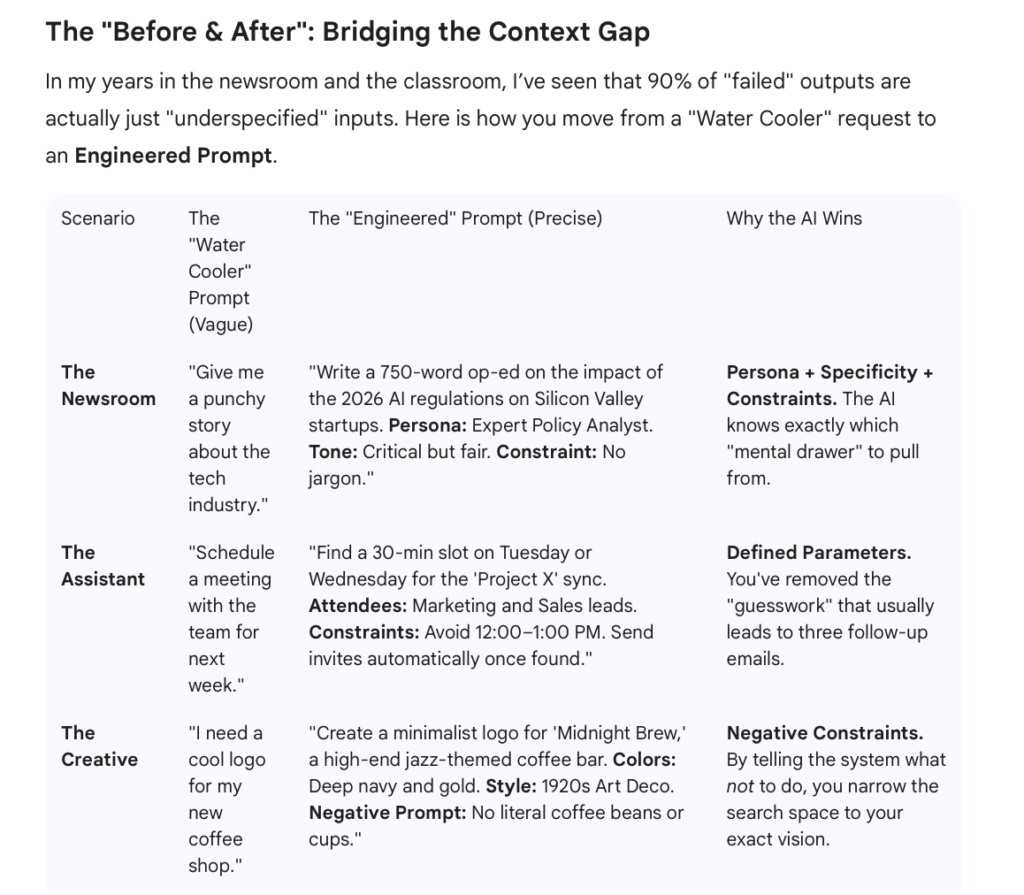
The Evolution of Instruction
Throughout history, we’ve tried various “scripts” to close the gap between intent and action:
- The Divine Prompt: The Bible is essentially a collection of high-stakes prompts. From “Let there be light” to the Ten Commandments, these were instructions designed to order chaos. Yet, we’ve spent millennia debating the interpretation of the output.
- The Macro-Prompt: JFK didn’t micromanage the nuts and bolts of a rocket. He set a massive, outcome-oriented prompt: “Put a man on the moon” (Goal) “before this decade is out” (Time Constraint) and “return him safely”(Safety Constraint).
- The Zero-Ambiguity Prompt: Sometimes, nuance is dangerous. Look at the back of an over-the-counter medicine bottle. That “Drug Facts” table is the gold standard of prompting. It uses “negative constraints” (Do not use if…) and “if/then logic” (If pregnant, ask a doctor). There is no room for “creative interpretation” on a Tylenol label.
The Extraction Prompt–Maduro
Fast forward to today, February 2026. We are still processing the shock of Operation Absolute Resolve (January 3, 2026)—perhaps the most complex prompt ever executed in the history of military-legal operations.
When President Trump gave the “Go” order to extract Nicolás Maduro and Cilia Flores from their Caracas bedroom, the prompt was remarkably specific. It included the targets, the parameters (minimize U.S. casualties), and the context (150 aircraft providing the “noise” to ensure a 30-minute extraction).
While we struggle to get a bot to write a recipe without hallucinating a weird ingredient, this mission proved that when a prompt is practiced, worded with extreme precision, and backed by high-quality data, the results are terrifyingly effective.
Ghost Prompting
We are now entering the era of Anticipatory Prompting, or what I call “Ghost Prompting.” This is the prompt you didn’t even have to write. When Amazon suggests a specific brand of coffee just as your bag is running low, they are using “Zero-Touch Interaction.” The system has learned your patterns so well that it prompts you before you can prompt it.
The Clarity of the Machine
So, let’s stop complaining when AI doesn’t give us what we want on the first try. Humans rarely get it right on the first try, either.
In fact, a well-worded AI prompt is often more effective than a request made to a colleague. Why? Because the AI doesn’t have an ego. It doesn’t have a bad back, it isn’t worried about its mortgage, and it doesn’t have a preconceived notion of what story it wants to write.
AI forces us to do what we should have been doing with each other all along: Be clear. Be specific. Define our constraints.
We are finally learning that the quality of the output depends entirely on the quality of the input. The art of the prompt isn’t just about technology; it’s the art of clear thinking—and, most importantly, the art of listening.
THE PROMPTING CHEAT SHEET: From the Water Cooler to the AI Box
A Guide by Mario García
Prompting isn’t just for machines—it’s the art of clear thinking. Use these four “Historical Archetypes” to engineer your next interaction, whether you’re talking to a reporter or a Large Language Model.
1. The “Kennedy” (Goal-Oriented Prompting)
The Lesson: Define the finish line and the deadline.
- The Goal: Clearly state the final output (e.g., “Land on the moon”).
- The Timeframe: Set a hard boundary (e.g., “By the end of this decade”).
- The Safety Rail: Include a “non-negotiable” (e.g., “Return him safely”).
AI Application: “Write a 500-word newsletter draft by 3:00 PM today that avoids all corporate jargon.”
2. The “Advil Bottle” (Constraint-Heavy Prompting)
The Lesson: Ambiguity is the enemy of execution.
- Negative Constraints: Tell the system what not to do (e.g., “Do not use if you have X”).
- If/Then Logic: Give the system a fork in the road (e.g., “If the tone is too formal, rewrite it to be conversational”).
- Structural Prompting: Ask for the output in a specific format (e.g., a table, a list, or a “Drug Facts” style box).
3. The “Mrs. Earle” (Contextual System Instructions)
The Lesson: Set the environment before you give the command.
- Persona: Tell the AI who it is (e.g., “Act as a veteran news editor with 30 years of experience”).
- The Vibe: Define the “hands under the desk” rules (e.g., “Your tone should be authoritative but encouraging”).
- The Audience: Who is this for? (e.g., “Write this for a high school level reader”).
4. The “Reagan” (The Power of the Direct Command)
The Lesson: Sometimes, simple and binary is best.
- Eliminate Fluff: Don’t say “I would appreciate it if you could maybe…” Just say “Execute.”
- High Contrast: Make the success or failure of the prompt easy to measure.
AI Application: “Summarize this 50-page PDF into three bullet points. No more, no less.”
🛠 The “Context Gap” Checklist
Before you hit “Enter” (or send that email to a colleague), ask yourself:
- Is it explicit? Did I assume they know something they might not?
- Is it constrained? Did I give them too much “creative liberty”?
- Is there a persona? Did I tell them how to think, not just what to do?
Pro Tip from Mario: Remember the “Grocery Store” glitch. If you don’t specify the 2% milk, don’t be surprised when the system brings you chocolate.
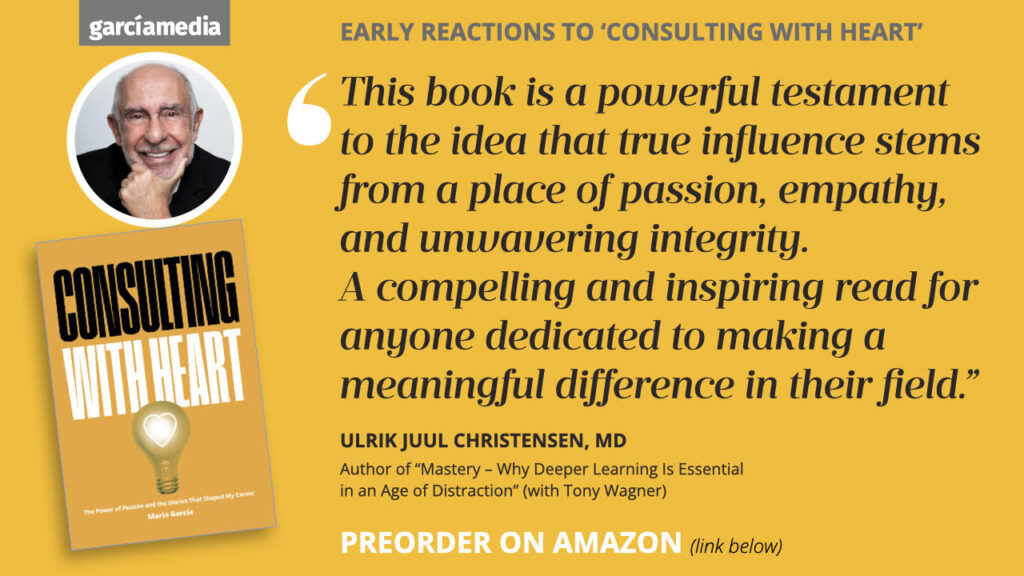
Consulting with Heart (2025)

Consulting with Heart — my 17th book—is here! Ready to order. Thanks for making it already the #1 Hot New Release for Media & Communications Books at Amazon.com. Also available from Apple, Barnes & Noble, Target, Torchlight.
Written from my more than 200 diaries. Fueled by people I have met along the way in my journey through 122 countries,
this book isn’t just about strategy. It is about my five-decade journey, 750+ projects and my role as an interpreter of dreams for my clients.
amazon.com/dp/1966629958; Apple Books – ebook
Highlight/Chapter 3: Our mission is clear: We are the chaperones of change. Our clients
look to us not just for solutions but for the courage to embrace the new
and different. Clients have nightmares of what they’re afraid will happen.
Consultants have to replace those with the dream and bring the dream
to reality. Being a change agent demands a unique blend of skills such as
a deep understanding of human psychology, an ability to communicate
effectively, and an unwavering commitment to the client’s goals.
Workshop deals with the two big revolutions facing editors
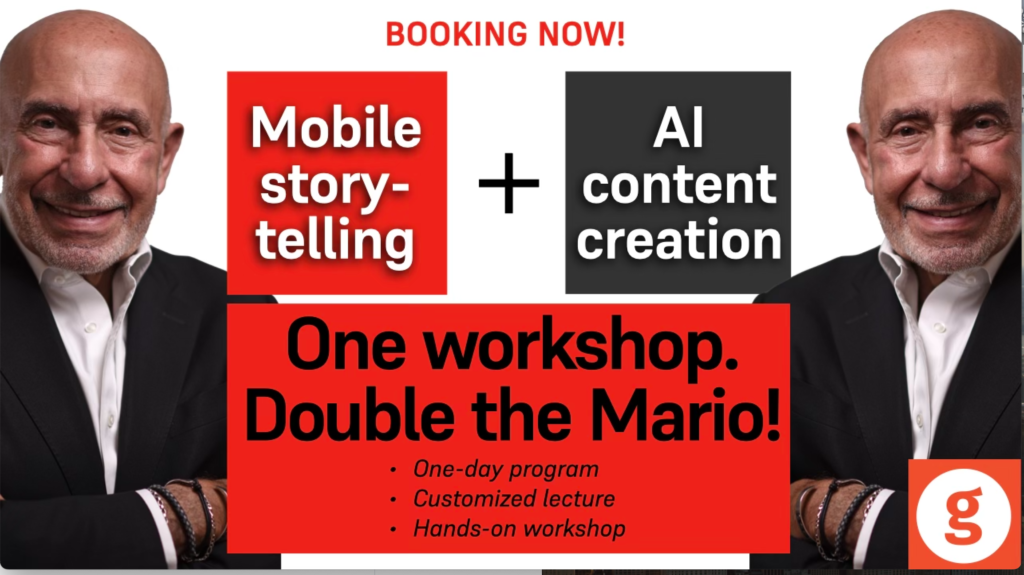
For me, it is imperative that editors approach content creation thinking in terms of mobile first.
Mobile first involves the type of transformation where all content is prepared thinking from small to large platform. Thinking small platform does not mean that the reporter conceptualizing a story for mobile consumption should not think BIG. So, plan from small to large, but think big in terms of the story content and the visual assets that go with it.
While mobile first is still elusive to so many newsrooms around the planet, here we are, in 2024, faced with an even bigger challenge not just knocking at our doors, but already IN: Artificial Intelligence.
Transformation and a change of mentality to face these challenges is the first step. Training and education to tackle them with a sense of focus and direction is essential.
That’s where our Garcia Media workshops come in
Our Garcia Media Mobile Storytelling workshops introduce your editorial team to the way we write, edit and design for mobile platforms. This one-day program includes a presentation and a hands-on workshop. We’ve added a new segment about AI for content creation.
Newsrooms around the planet have gone mobile-first after a Garcia Media workshop!
Our Garcia Media Mobile Storytelling workshops are proven to introduce your editorial team to the way we write, edit and design for mobile platforms. It is a one-day program that involves a presentation (where I summarize my Columbia University class content), and follow it with a hands on workshop.
For details, to customize, and to book: mario@garciamedia.com
How we use AI
Honored to be mentioned here:
Order my AI book here:
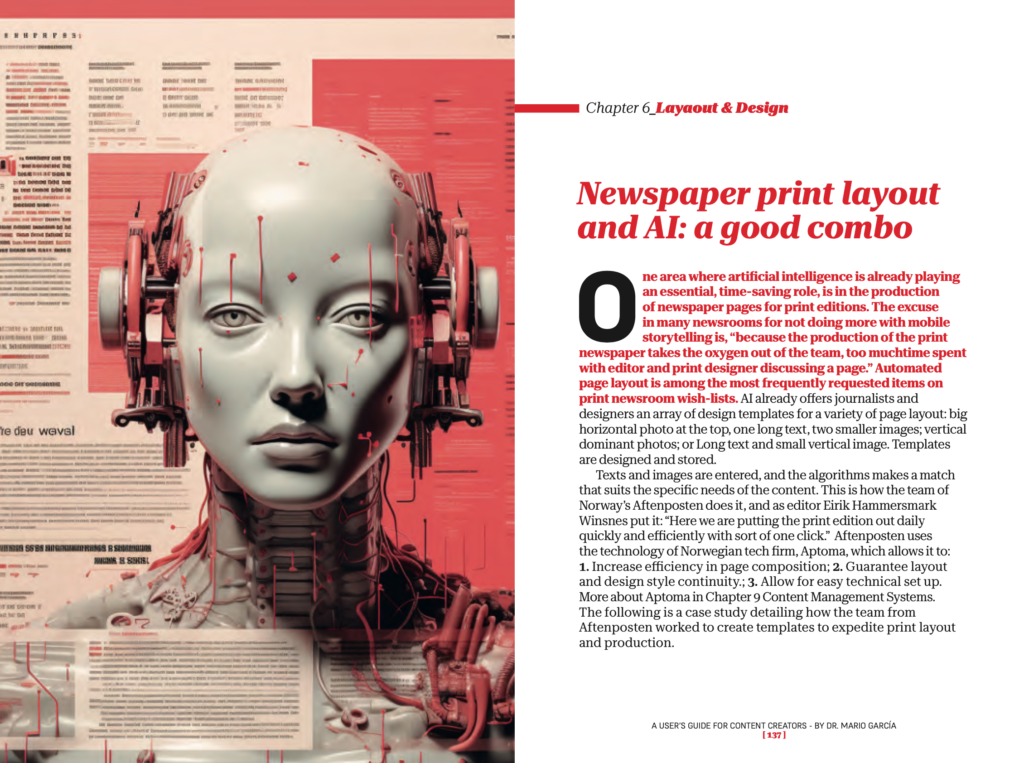
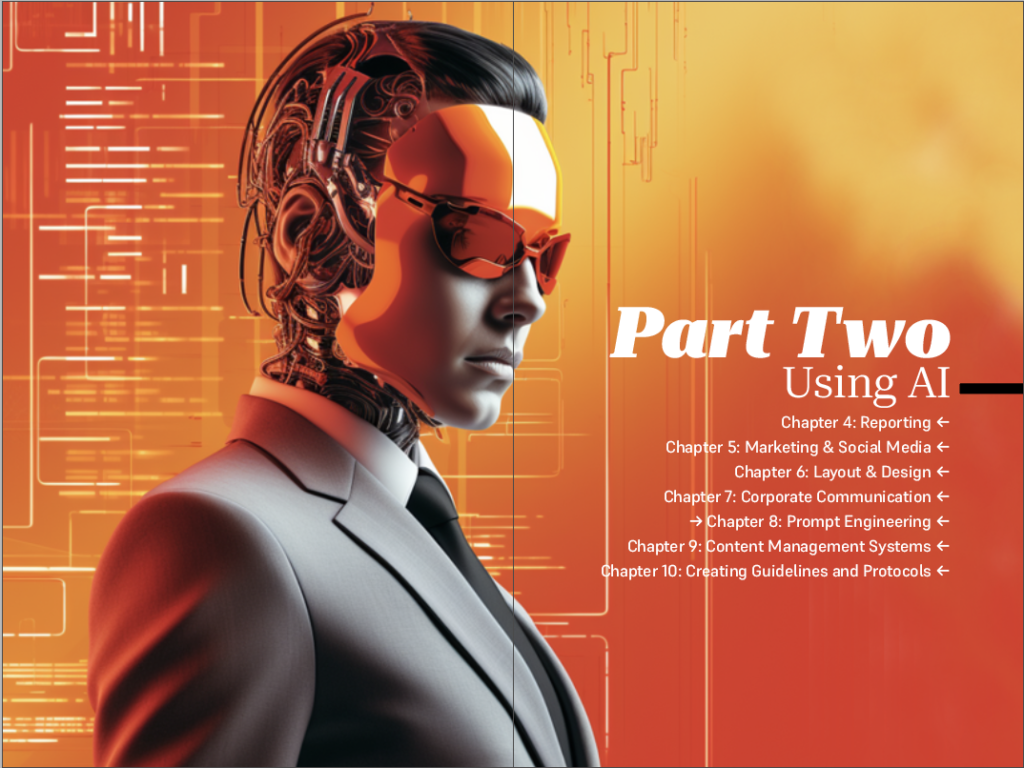
Here is a chance to pre-order my new book about Artificial Intelligence and content creation. The first 25 copies sold will be signed! Order here:
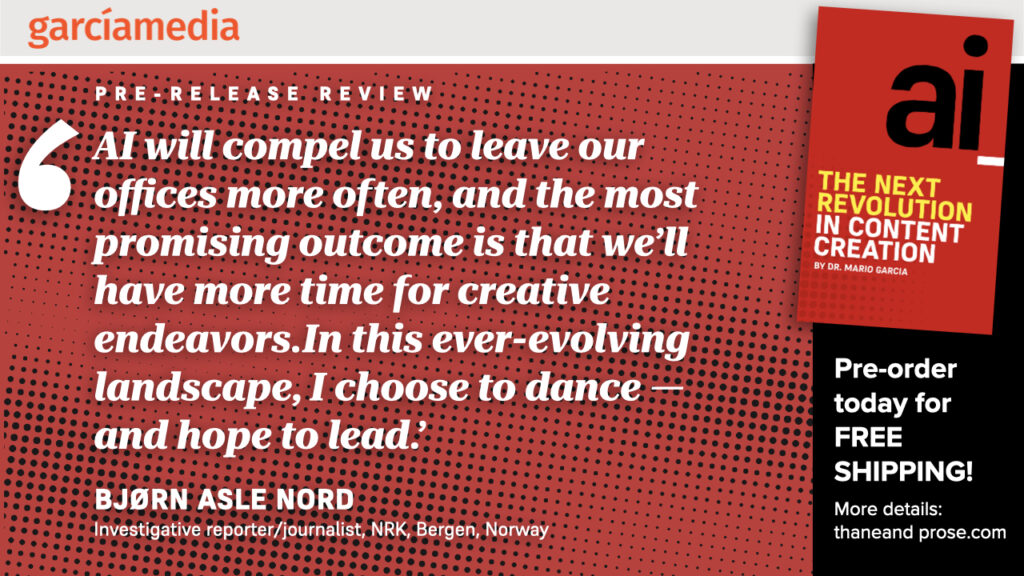
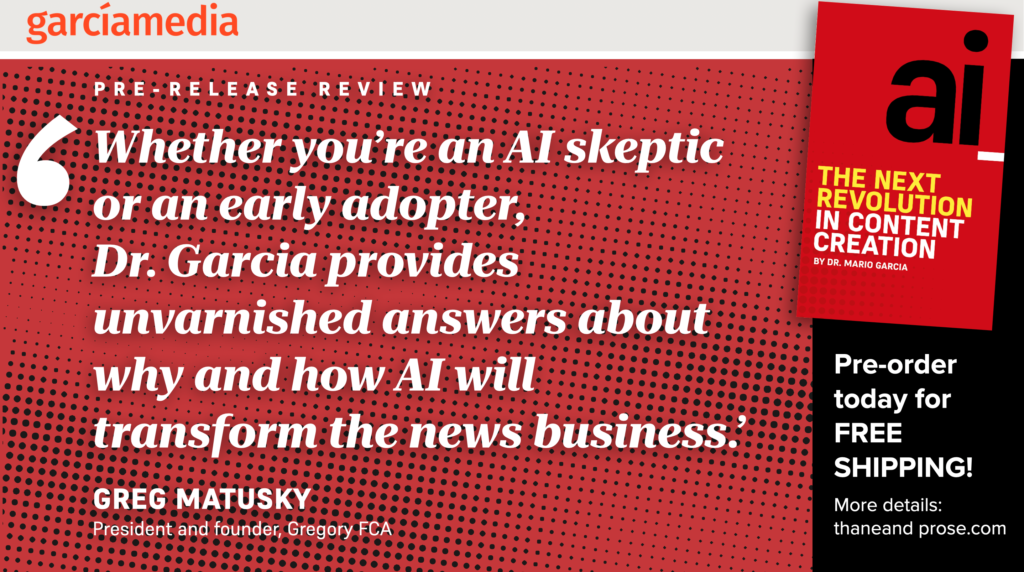
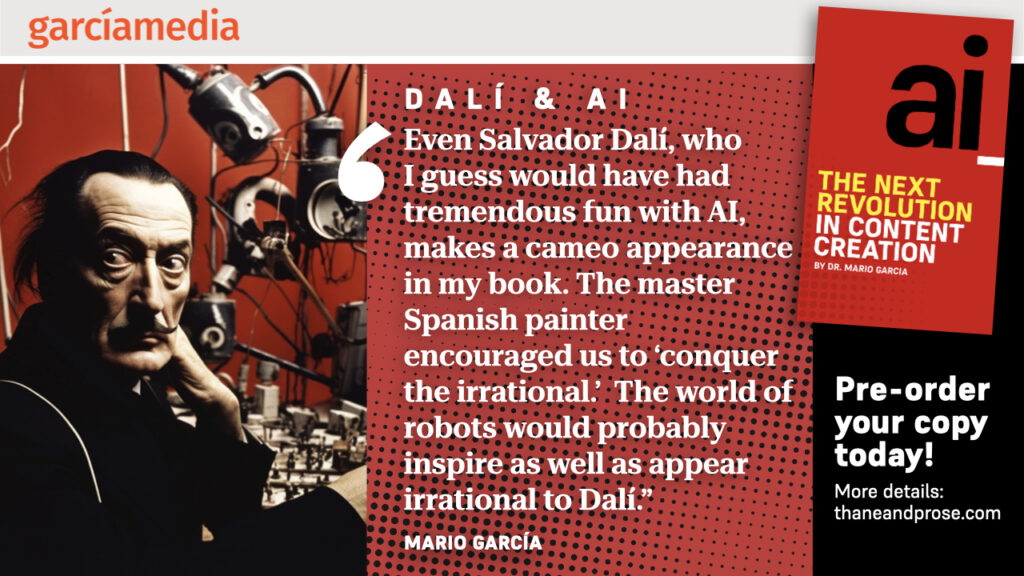
Reviews for AI book:

Did you read The Story yet?
I urge you to consult my latest book, The Story, a trilogy full of tips and explanations about mobile storytelling, which represents the latest genre for journalists to explore. See information below:
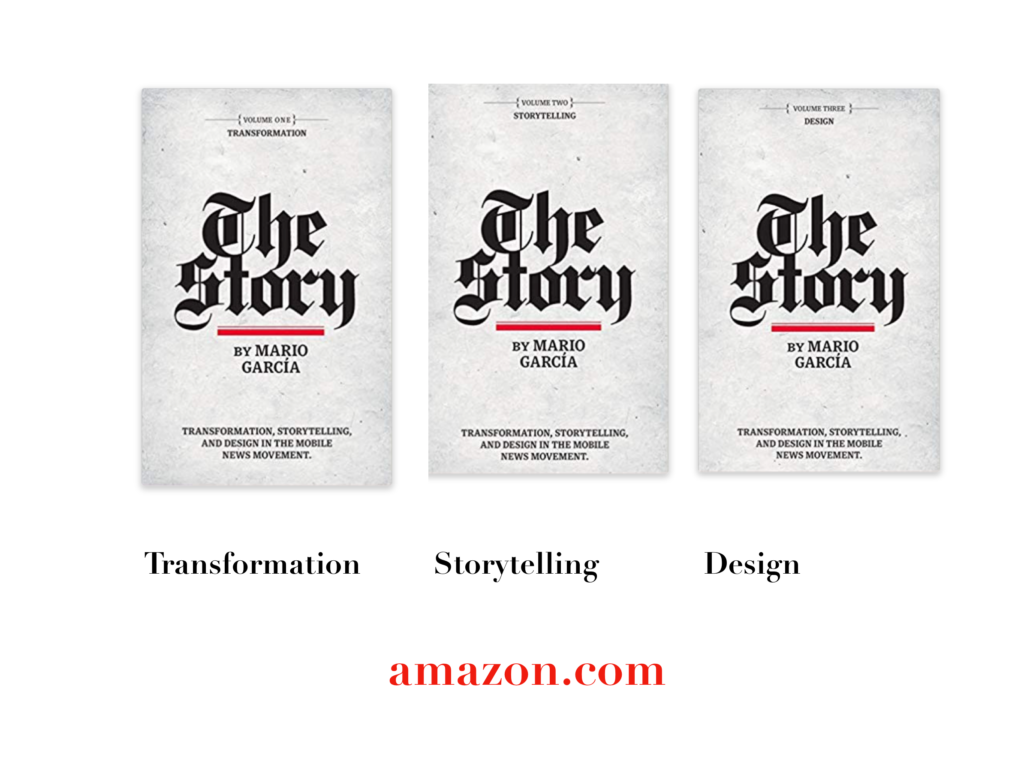
The full trilogy of The Story now available–3 books to guide you through a mobile first strategy. Whether you’re a reporter, editor, designer, publisher, corporate communicator, The Story is for you! https://amazon
Volume 1: Transformation
Volume Two: Storytelling
Volume Three: Design
Order the print edition of The Story, from Amazon, here:
TheMarioBlog post #4012