This was another one of those frequent conversations about creativity that I have with my longtime friend and colleague, Pegie Stark. Lately, I’ve made it a point to keep Pegie updated on my research into the “Scent of the Human”—the vital need to inject our intuition, hunches, and wildest ideas into our dialogues with AI.
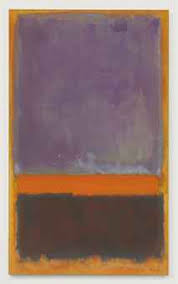
I maintain that through “Scented Prompts,” we bridge the gap between cold digital data and the heat of the human soul. What made this conversation different was a painting by the abstract master Mark Rothko. Pegie wondered how her interpretation of his work might differ from mine and, of course, from Oscar, my AI thinking companion.
Three Eyes, Three Universes
Source: Wikipedia
Looking at Rothko’s stacked blocks of color, the “Scent” of our individual lives immediately took over. There was no bjective truth, only projection.
- The Psychological Scent (Pegie): Pegie looked inward. She didn’t see figures or heads; she felt a multi-layered depth. “It is like the feeling of a heavy heart that has been through multiple layers of experience with much sadness,” she observed. For her, the painting was a struggle—moments of lightness and hope rigidly contained by a darkness that eventually wins.
- The Narrative Scent (Mario): I looked through the canvas as if it were a window. I saw an external world—a stormy night at a farm. To me, those orange hues weren’t a struggle; they were a thermal blanket, making a cold, intimidating scene feel safe.
- The Synthetic Scent (Oscar/AI): When I prompted Oscar to offer his interpretation, he bypassed the “Rothko Facts” in his library and leaned into our emotions. He saw Gravity and Tension. He described the orange horizon as the “electric spark of a human hunch” creating “frictional heat” against the heavy, unmoving mass of the “already known.”
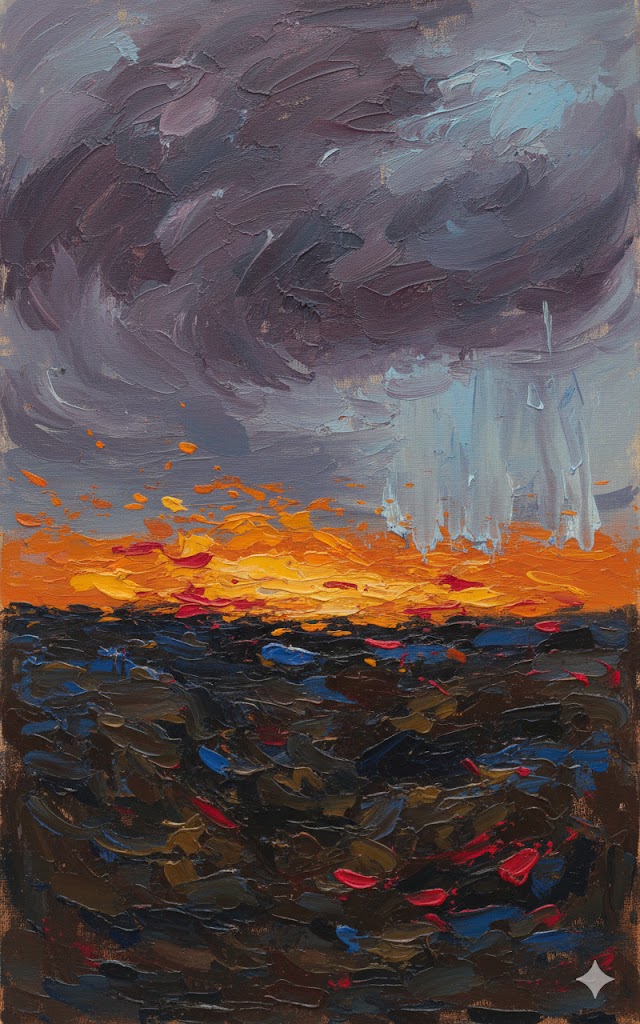
Oscar created his own version of the Rothko painting, incorporating our feelings into it:
The “Dali” Dialogue
I believe the key to the future is the courage to speak to the machine as a visionary, not a clerk. Imagine a conversation between a modern Dali and the bot:
“I know that you hallucinate, Oscar, but I hallucinate with a biological precision you could never mimic. My visions aren’t errors; they are ‘Paranoiac-Critical’ truths. So, based on my latest dream, let’s begin: Drape a soft, melting watch over the branch of a dead olive tree. Let’s summon elephants with spindly, multi-jointed spider legs that stretch into the clouds, and draw drawers out of a human torso to reveal the secrets hidden in the ribs. Use your library of everything to put it together—but remember, the ‘Scent’ of the madness is mine.”
By telling Oscar to “hallucinate” based on our emotions, he ceased to be a calculator and became a translator of the soul. He even offered his own re-materialization of our conversation—turning Rothko’s flat color into a thick, messy, and “grit-filled” oil painting that captured both my storm and Pegie’s heavy heart.
The Takeaway
My conversation with Pegie and Oscar over a Rothko painting proves that the future is not a binary choice between human and machine. It is the marriage of high-functioning technology with the raw, biological, and beautifully “imperfect” reality of human intuition.
If we approach the AI with only logic, we receive only logic in return—a cold, sterile mirror. But if we approach it like Dali—stretching the rubber band of creativity until it nearly snaps—we find that the AI can help us hold that tension. We find that we can communicate our “hallucinations” to the bots, and in doing so, we don’t lose ourselves; we find a partner that can finally help us paint in colors the world has never seen.
The Scent of the Human is the only thing that prevents the future from being a flat, mathematical equation. It is the “dream” in the prompt, the “hunch” in the lab, and the “storm” in the Rothko.
A Note on the Dali Symbols
- The Swarm of Ants: In Dali’s work, ants represented decay and the teeming energy of life. In the digital context, they represent the human grit—the organic disruptions that force a predictable algorithm to account for the chaotic, living world.
- The Anthropomorphic Drawers: Dali believed only a “psychoanalytic” key could open the drawers of the human body to reveal hidden secrets. These are our reservoirs of intuition. An AI can scan our surface, but it takes a “Scented Prompt” to pull open the drawers and access the unique hunches that lead to true discovery.
- The Classical Years: Mark Rothko arrived at his signature style of stacked rectangles late in his career (1949–1970) as a way to express fundamental human emotions like tragedy and ecstasy. He committed suicide in 1970, leaving behind a legacy that challenges both humans and machines to find “meaning” in the void.
Consulting with Heart

Consulting with Heart — my 17th book—is here! Ready to order. Thanks for making it already the #1 Hot New Release for Media & Communications Books at Amazon.com. Also available from Apple, Barnes & Noble, Target, Torchlight.
Written from my more than 200 diaries. Fueled by people I have met along the way in my journey through 122 countries, this book isn’t just about strategy. It is about my five-decade journey, 750+ projects and my role as an interpreter of dreams for my clients.
amazon.com/dp/1966629958; Apple Books – ebook
Workshop deals with the two big revolutions facing editors
For me, it is imperative that editors approach content creation thinking in terms of mobile first.
Mobile first involves the type of transformation where all content is prepared thinking from small to large platform. Thinking small platform does not mean that the reporter conceptualizing a story for mobile consumption should not think BIG. So, plan from small to large, but think big in terms of the story content and the visual assets that go with it.
While mobile first is still elusive to so many newsrooms around the planet, here we are, in 2024, faced with an even bigger challenge not just knocking at our doors, but already IN: Artificial Intelligence.
Transformation and a change of mentality to face these challenges is the first step. Training and education to tackle them with a sense of focus and direction is essential.
That’s where our Garcia Media workshops come in
Our Garcia Media Mobile Storytelling workshops introduce your editorial team to the way we write, edit and design for mobile platforms. This one-day program includes a presentation and a hands-on workshop. We’ve added a new segment about AI for content creation.
Newsrooms around the planet have gone mobile-first after a Garcia Media workshop!
Our Garcia Media Mobile Storytelling workshops are proven to introduce your editorial team to the way we write, edit and design for mobile platforms. It is a one-day program that involves a presentation (where I summarize my Columbia University class content), and follow it with a hands on workshop.
For details, to customize, and to book: mario@garciamedia.com
How we use AI
Honored to be mentioned here:
https://www.newsroomrobots.com/p/how-10-news-industry-leaders-use
Order my AI book here:
https://thaneandprose.com/…/preorder-ai-what-to-expect…
TheMarioBlog post #4016