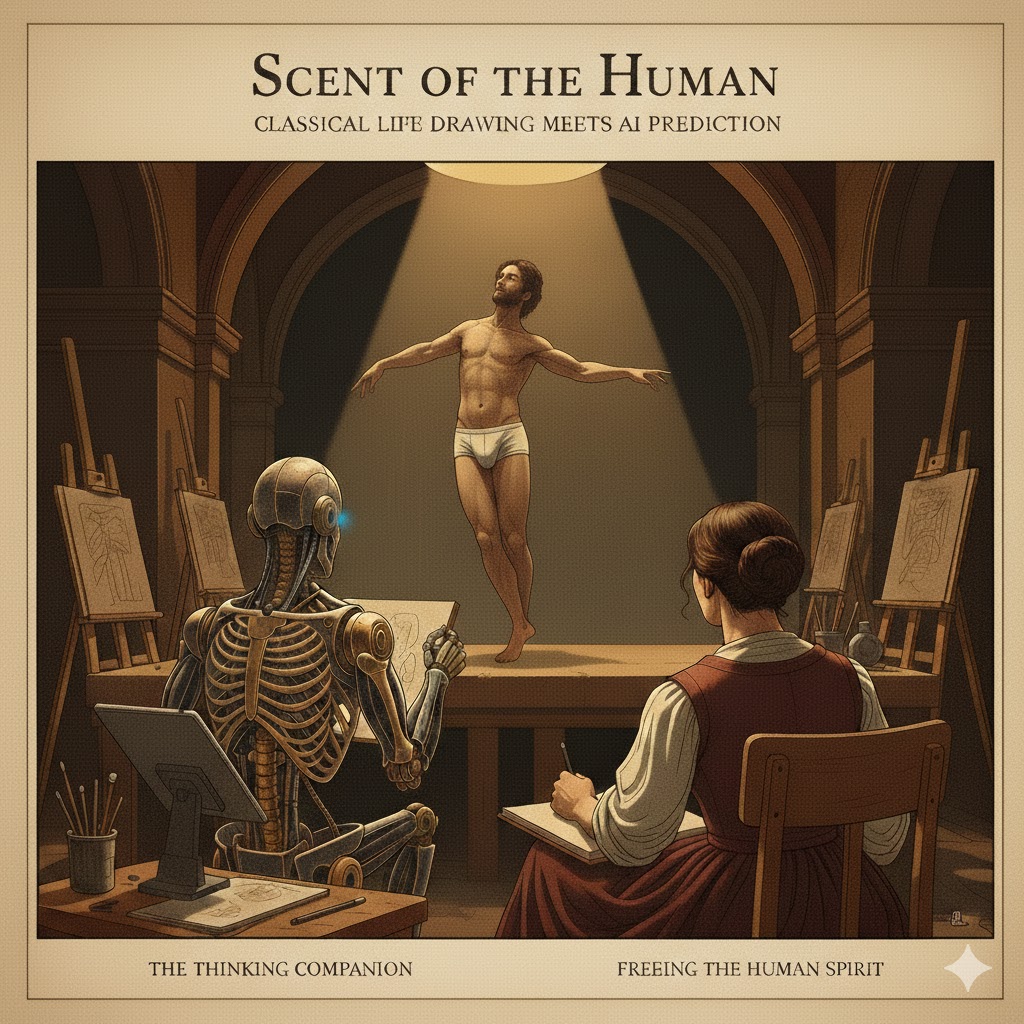
I have been a man on a quest to discover the boundaries of human creativity in the era of artificial intelligence. In my previous explorations, I have argued that “scented prompts”—those rich, sensory, and context-heavy instructions—move AI from the “utility” side of the ledger to the “creative” side.
We have explored this through the lens of movement (the “weight” of a Bob Fosse choreography), architecture (the salt-air structures of a museum in Lanzarote), and engineering (hanging bridge in Sydney). But recently, a dear friend and brilliant artist, Pegie Stark, posed a new challenge:
Can the “scent” of a prompt enhance the classical tradition of life figure drawing?
The Workflow: From Poetic Idea to Professional Practice
In photography, AI can act as a digital gaffer, helping a photographer pre-visualize lighting and composition before a shutter is ever pressed. For the illustrator, the “scent” is not just a metaphor; it is a pre-visualization tool.
Step 1: Crafting the Scented Prompt
I asked Pegie to provide a prompt for her upcoming session, urging her to include specific artistic influences. She wrote:
“A life drawing class in an art studio with morning light. The model is a 25-year-old woman, slim with short red hair, wearing a translucent veil and sitting in an easy chair reading. Style: Michelangelo. Medium: Charcoal. The air is cool; the smell of jasmine drifts through the window.”
Step 2: The AI Interpretation
I used Pegie’s scented prompt, complete with details and nuances of how she imagined the session, and passed it on to Oscar, my AI thinking companion. This is how Oscar responded:
“As her “thinking companion,” I processed this through a Renaissance lens, focusing on terribilità—the emotional intensity and muscular “weight” characteristic of Michelangelo—balanced with the delicate, smoky sfumato of charcoal.”
How the AI “thought” through the creative ledger:
- The Michelangelo Constraint: The AI interprets this as a directive to emphasize “architecture” over “flatness,” looking for the tension in the neck and the skeletal structure of the limbs.
- The Sensory Influence: The mention of “jasmine” and “cool breeze” discourages a “grimy” charcoal output, pushing the AI toward a cleaner use of negative space to represent fresh air.
- The Veil Paradox: Drawing transparency in charcoal is a master-level task. The AI uses the “scent” to balance the hardness of the chair with the softness of the fabric.
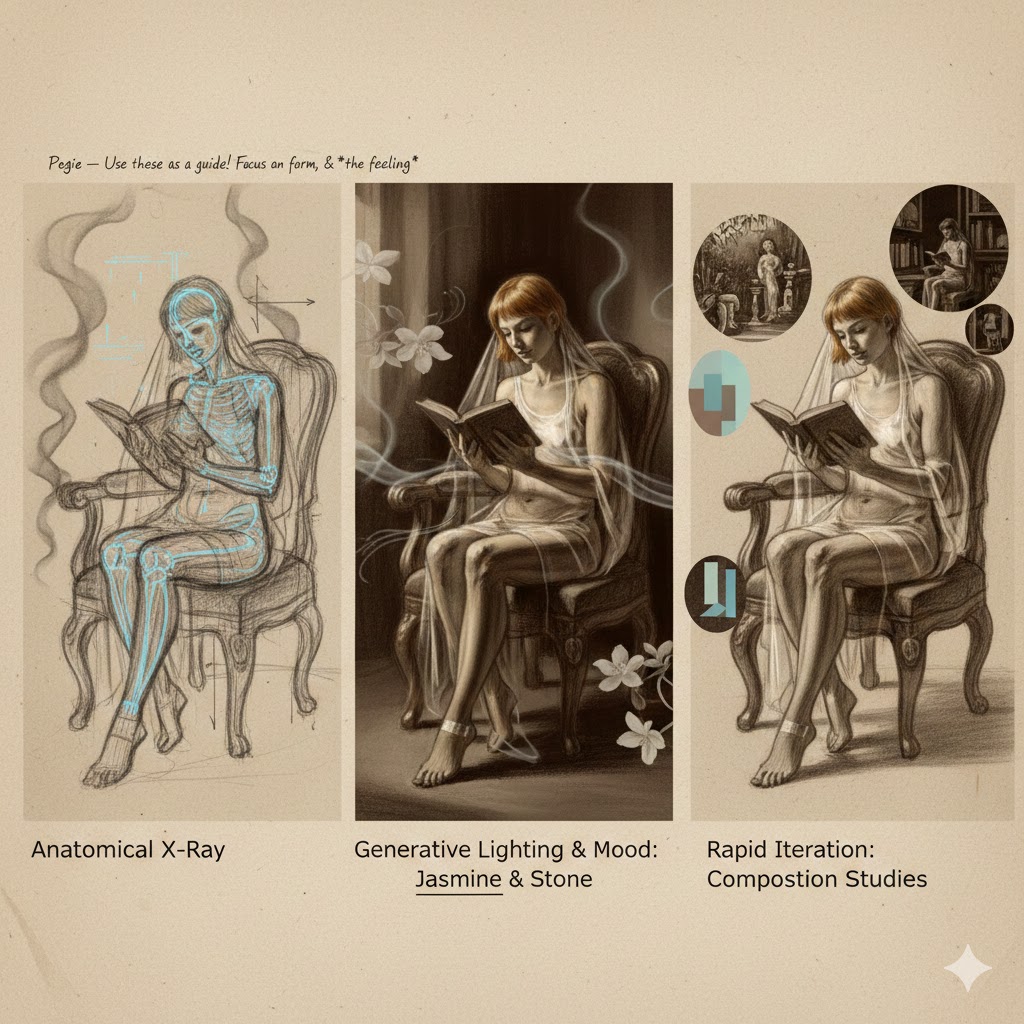
Oscar immediately developed these visualizations:

The Human Reaction: The “Spirit” vs. The “Mechanical”
When I showed Pegie these visualizations, her reaction was illuminating. She noted that while the AI captured the data—lighting, weight, and structure—it missed the meditative exchange between artist and model.
“The result is not what I saw in my mind. I wait for an energy exchange; I feel their personality before I start drawing. But AI focused on the ‘mechanical’—the skeletal structure and the lighting. I find the anatomical overlay most useful as a reference, but for me, the gesture comes from the spirit, not the data.”
The “Thinking Companion” Manifesto for Artists
This experiment proves that AI is not the “artist”; it is the Scenographer. It handles the “thinking” regarding lighting physics and anatomical layering, freeing the human to focus on the feeling.
Here is how the modern artist can use the “Scented Studio” workflow:
- The “Scented” Setup: Use AI to “audition” lighting. Prompting for “4:00 PM winter sun and the smell of turpentine” allows you to adjust your physical studio lights to match a specific mood before the model arrives.
- The Anatomical Anchor: Use AI to create an “anatomical map” of a difficult pose. Having a Caravaggio-style study of the model’s musculature on a tablet next to your easel helps you “carve” the charcoal with more authority.
- The Medium Morph: If stuck in a rut, ask the AI to “scent” the medium. Translate your charcoal sketch into the “heavy, aggressive oil sticks of Lucian Freud.” This forces your hand to break its muscle memory.
Case study with Da Vinci as inspiration
Anatomical Anchor: “The Vitruvian Pose” by AI (Da Vinci Style)
For an artist studying human proportion and dynamic tension, a “scented prompt” could request a foundational anatomical study. Here, we’ll aim to blend Da Vinci’s scientific precision with his artistic grace.
The “Scented Prompt”:
“A detailed anatomical study of a male figure in a contrapposto pose, reminiscent of Da Vinci’s meticulous drawings. Emphasize the underlying skeletal structure and muscle groups, especially the interplay of tension and relaxation. The drawing should convey the intellectual rigor of a scientific illustration combined with the artistic flow of a master’s sketch. Imagine the lighting is soft, diffused studio light, revealing subtle contours. The medium is red chalk on toned paper, showing Da Vinci’s characteristic hatching and cross-hatching.”
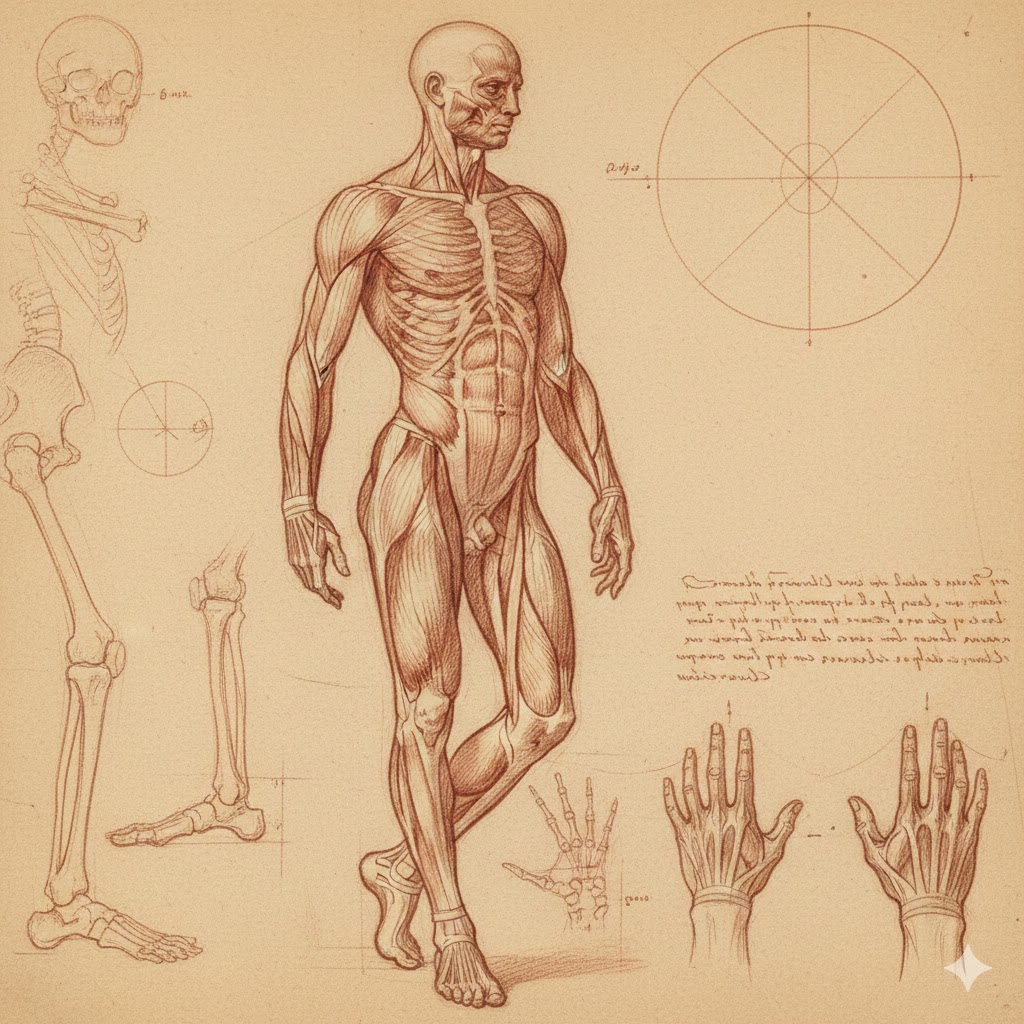
Here is the AI-generated “anatomical anchor” for Da Vinci:

Applying the Da Vinci “Anatomical Anchor” in a Life Drawing Class
Pegie’s observation about the “mechanical” details being secondary to the “spirit” of the model is crucial. The AI-generated anatomical anchor, however, offers a powerful tool for pre-visualization and structural understanding, allowing the artist to internalize these “mechanical” aspects before even lifting a charcoal stick.
1. Pre-Visualization of Form and Function: Before the live model even takes their pose, an artist can use this Da Vinci-esque AI study to mentally prepare. For instance, if the model is planned to take a contrapposto stance, the artist can study the AI’s rendering to see how the weight shift impacts the rib cage, pelvis, and the engagement of specific muscle groups (e.g., the trapezius, obliques, and quadriceps). This mental exercise, guided by the AI’s detailed “scented” output, primes the artist’s eye to look for these subtle shifts in the live model, rather than merely guessing at them. As Kenneth Clark notes in Leonardo da Vinci: An Account of his Development as an Artist, Da Vinci’s drawings were not just art, but “investigations into the secrets of nature.” The AI, here, facilitates a similar investigation.
2. Understanding Dynamic Tension and Relaxation: Da Vinci was a master of capturing the dynamic equilibrium of the human body, even in repose. Notice in the AI image how the contrapposto pose naturally creates tension on one side of the body (the weight-bearing leg) and relaxation on the other. An artist can use this reference to understand how muscles lengthen and contract, and how the skeleton provides the underlying “architecture.” When drawing the live model, the artist can consciously seek out these points of tension and relaxation, giving their own drawing a greater sense of anatomical veracity and dynamism. This moves beyond simply drawing what the eye sees to understanding why the body looks the way it does in that specific pose.
3. Enhancing Proportional Accuracy: Da Vinci’s legacy includes his meticulous studies of human proportion, most famously the Vitruvian Man. While the AI image isn’t a direct copy, it embodies this proportional rigor. An artist can use this AI anchor to gauge the relative lengths of limbs, the size of the head in relation to the torso, and the overall balance of the figure. If a student is struggling with foreshortening, for example, they can compare their live sketch to the AI’s “idealized” Da Vinci perspective to identify where their proportions might be falling short, thus sharpening their observational skills.
4. The “Medium Morph” for Classical Techniques: The prompt specified red chalk on toned paper, a medium Da Vinci frequently employed. The AI output captures the distinct texture and subtle tonal variations of this choice. An artist can use this as a reference not just for anatomy, but for technique. How does Da Vinci use cross-hatching to build form? Where does he leave areas of the toned paper exposed to create highlights? This becomes a visual masterclass, encouraging the artist to experiment with similar classical rendering methods to achieve depth and texture in their own charcoal or sanguine drawings.
By leveraging an AI-generated “anatomical anchor” like this, artists can bridge the gap between abstract anatomical knowledge and the immediate observation required in a life drawing class. It allows them to internalize the “mechanical” framework, freeing their mind to connect more deeply with the “spirit” and unique presence of the live model, ultimately leading to more informed and expressive artwork.
From Atmosphere to Anatomy: The Scented Studio
When applied to the life drawing class, the AI becomes more than a generator; it becomes your Creative Co-Pilot for setup and execution. Here is how artists can use this “scent” to sharpen their own craft:
1. The “Scented” Setup: Engineering the Mood
Before the model even strikes a pose, the artist can use a scented prompt to “audition” the lighting and color palette.
- The Concept: Instead of standard overhead fluorescent light, you prompt the AI with: “A life drawing studio at 4:00 PM, low-hanging winter sun, the smell of old wood and turpentine.”
- The AI Assist: The AI generates a reference that shows you how warm, elongated shadows will interact with the model’s form.
- The Execution: The artist can then adjust the physical studio lights or their own color choices to match that specific “scent” of time and place.
2. The “Anatomical Anchor”: Seeing Through the Skin
Life drawing is a battle between the eye and the ego. We often draw what we think a leg looks like rather than the bone and muscle underneath.
- The Concept: Use the AI to “scent” the anatomy.
- The AI Assist: An artist can ask for a Caravaggian study of a specific pose. The AI emphasizes the intercostal muscles and the scapula through high-contrast lighting. See male model at the window here:

Final Thought
“Scented prompts” allow the artist to outsource the calculation so they can reclaim the inspiration. By treating AI as a universal crane for the heavy lifting of data, the artist remains firmly in the pilot’s seat, anchored by the irreducible Scent of the Human.
Of related interest: The Scent of the Human series
Human Creativity and the Scent of the Human in the AI era
The Architect’s Scent: Giving AI a Nervous System for Buildings and Bridges
The Educated Zombie: Why AI’s Next Great Leap Isn’t About Words, But Weight
The Art of the Prompt: Why AI is Finally Teaching Us to Speak Human.
Marking the Spot: Why the Future of Storytelling Belongs to the Augmented Humanist
In the era of AI, we must catch the scent of the writer
Related material:
How ‘Scent Of The Human’ Leaves A Sensory Trail Amid AI Content
What the iconic writers of New Journalism can teach us in the AI era
The distinct human writer becomes more essential
Staying Authentic in the Era of AI
https://wan-ifra.org/2025/08/the-scent-of-the-human-staying-authentic-in-the-age-of-ai/
Consulting with Heart (2025)

Consulting with Heart — my 17th book—is here! Ready to order. Thanks for making it already the #1 Hot New Release for Media & Communications Books at Amazon.com. Also available from Apple, Barnes & Noble, Target, Torchlight.
Written from my more than 200 diaries. Fueled by people I have met along the way in my journey through 122 countries, this book isn’t just about strategy. It is about my five-decade journey, 750+ projects and my role as an interpreter of dreams for my clients.
amazon.com/dp/1966629958; Apple Books – ebook
Workshop deals with the two big revolutions facing editors

For me, it is imperative that editors approach content creation thinking in terms of mobile first.
Mobile first involves the type of transformation where all content is prepared thinking from small to large platform. Thinking small platform does not mean that the reporter conceptualizing a story for mobile consumption should not think BIG. So, plan from small to large, but think big in terms of the story content and the visual assets that go with it.
While mobile first is still elusive to so many newsrooms around the planet, here we are, in 2024, faced with an even bigger challenge not just knocking at our doors, but already IN: Artificial Intelligence.
Transformation and a change of mentality to face these challenges is the first step. Training and education to tackle them with a sense of focus and direction is essential.
That’s where our Garcia Media workshops come in
Our Garcia Media Mobile Storytelling workshops introduce your editorial team to the way we write, edit and design for mobile platforms. This one-day program includes a presentation and a hands-on workshop. We’ve added a new segment about AI for content creation.
Newsrooms around the planet have gone mobile-first after a Garcia Media workshop!
Our Garcia Media Mobile Storytelling workshops are proven to introduce your editorial team to the way we write, edit and design for mobile platforms. It is a one-day program that involves a presentation (where I summarize my Columbia University class content), and follow it with a hands on workshop.
For details, to customize, and to book: mario@garciamedia.com
How we use AI
Honored to be mentioned here:
https://www.newsroomrobots.com/p/how-10-news-industry-leaders-use
Order my AI book here:
https://thaneandprose.com/…/preorder-ai-what-to-expect…

TheMarioBlog post #4015